
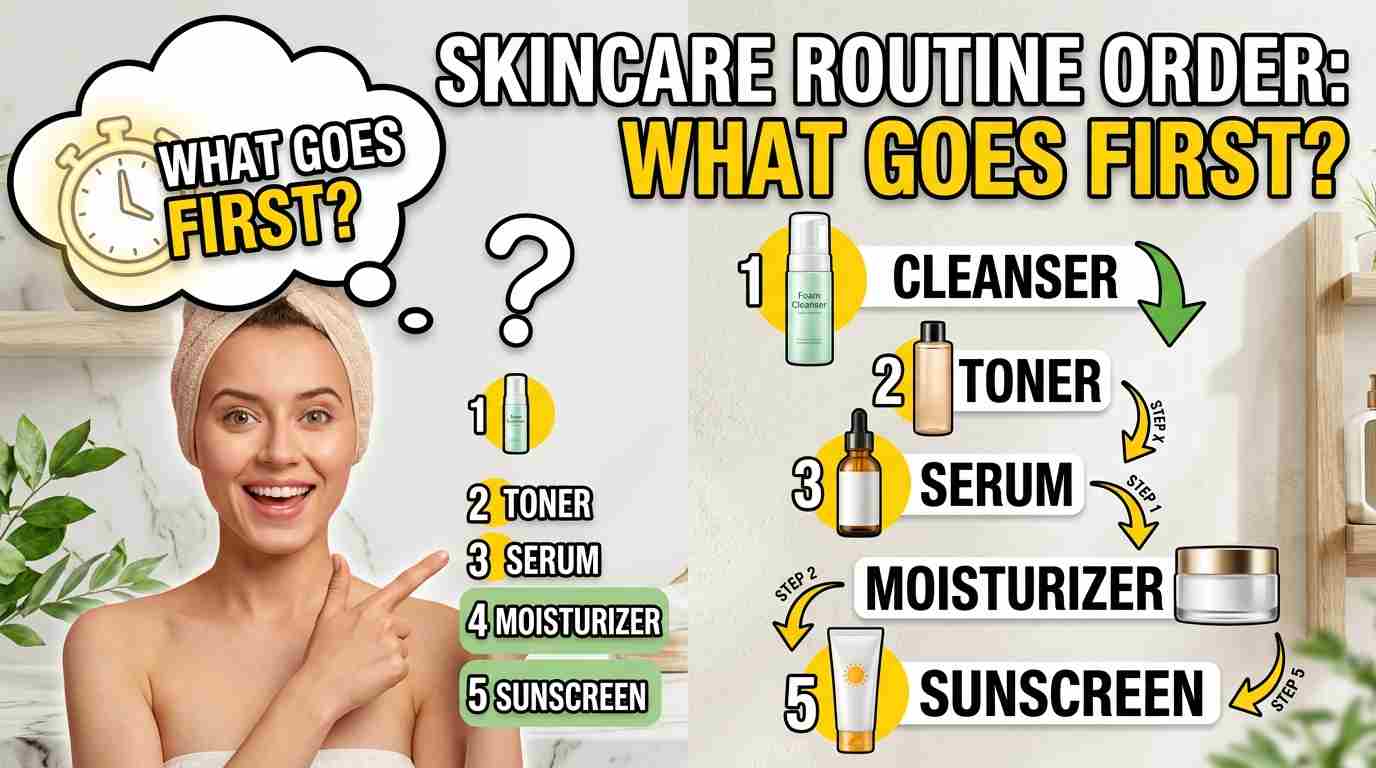

As a clinical aesthetician, I often meet clients who own good skincare products but are unsure about the correct order in which to apply them. Using products in the wrong sequence can lead to pilling, irritation, or uneven sunscreen coverage. This is the same simple skincare routine order guide I give my clients to help them understand what goes first, which steps are optional, and how to build a morning and nighttime routine that suits their skin.
You don’t need 10 products in your skincare routine. A good cleanser, appropriate moisturizer, and a daily SPF will cover a base. Treatments should only be added if they address specific skincare concerns, like dryness, dullness, acne, or blackheads.
Know which skin type you have before creating a routine
Your skin type is a guide in choosing the right cleanser, moisturizer and treatment. Also, it may change due to weather, hormones, age or product use.
Oily Skin
Oily skin is characterized by a shiny appearance and also tends to break out in clogged pores and blackheads. I recommend a gentle gel cleanser, a lightweight moisturizer and ingredients like niacinamide or salicylic acid.
Dry Skin
Dry skin can be tight, rough or flaky. For that choose a creamy cleanser and a moisturizer that contains ceramides, glycerin or hyaluronic acid.
Combination Skin
Combination skin tends to be oily on the forehead, nose and chin and dry on the cheeks. Apply oil-control products and use moisturizer all over your face.
Sensitive Skin
Sensitive skin may burn, turn red or sting after using some products. Try fragrance-free options out and at which time only introduce one new ingredient.
Acne-Prone Skin
Acne-prone skin can present with blackheads, whiteheads, or inflamed pimples. Salicylic acid works well for clogged pores and also for blackheads on the nose, and benzoyl peroxide may help to control acne-causing bacteria.
The Correct Skincare Routine at a Glance
Wash your face, apply a medicated or treatment product, then a moisturizer or sunblock according to recommendations by the American Academy of Dermatology. Makeup should be applied after skincare. Provided by American Academy of Dermatology
An example order of typical skincare products:
| Morning routine | Night routine |
| Cleanser | Makeup remover or cleansing balm |
| Toner | Cleanser |
| Treatment or antioxidant serum | Toner |
| Hydrating serum | Acne treatment or retinoid |
| Eye cream | Hydrating serum |
| Moisturizer | Eye cream |
| Sunscreen | Moisturizer |
| Makeup | Facial oil |
This is meant to be a guide, not rigid rules overriding a product’s usage instructions. Rx and certain acne products might be different, as product directions will need to be followed.
Morning Skincare Routine Order
A morning skincare routine’s purpose is to wash away the oil and dirt of the overnight period and prepare your skin for the day. It will support your moisture barrier and protect against the sun. For most people, this is three to five steps long.
1. Start with a gentle cleanser
Choose a cleanser that washes away sweat and excess oil but doesn’t leave your face feeling tight and stripped. Wash your face with lukewarm water, gently massage the cleanser with your fingertips, then rinse well and pat your skin dry.
It is a good idea to avoid scrubbing brushes and rough washcloths if your skin is sensitive or prone to breakouts.
If your skin is very dry or easily irritated, you can try rinsing your face with only water in the morning and cleansing at night. If you have acne-prone or oily skin, then washing with a cleanser twice a day is beneficial.
2. Use toner only if it serves a purpose
Toner is entirely optional; you won’t ruin your routine if you skip it. Hydrating toners can make skin feel more comfortable if it is dry or sensitive. If a toner has an exfoliating acid, it needs to be considered a “treatment” and be compatible with other actives you are using. You will have issues applying it to a routine already rich with different potent ingredients.
3. Apply a targeted treatment or antioxidant
Treatments should generally go onto clean skin so they can make direct contact with the area you want to address. Follow the directions on the product or instructions from your dermatologist.
Vitamin C is commonly used during the morning before sunscreen. The American Academy of Dermatology recommends applying it after washing and before sunscreen. AAD skincare guidance
If you use a prescription treatment, ask the prescriber where it belongs in your routine. Do not rely only on the “thinnest to thickest” rule for medication.
4. Add a hydrating serum
A hydrating serum can be used after a treatment and before moisturizer. Hyaluronic acid and glycerin are common humectants, which means they help attract water.
Apply a hydrating serum to slightly damp skin unless its label says otherwise. Follow it with moisturizer so that the added hydration does not quickly evaporate.
If your sunscreen already feels moisturizing and your skin is comfortable, you may not need a separate serum.
5. Eye cream (if used).
Eye cream is not essential; the facial moisturizer usually provides enough hydration around the eyes. If you apply an eye cream, gently pat a small amount around the orbital bone, not near the lash line unless specifically intended for that area. A heavy eye cream should be placed after lighter serums; otherwise, it will form a barrier and the serum won’t spread evenly.
6. Seal in moisture
Moisturizer helps prevent water loss and is important for the outer skin barrier. Apply it after serums and treatments. Choose a texture appropriate for your skin: light gel or lotion for oily skin, cream for dry skin, fragrance-free for sensitive skin or “non-comedogenic” for acne-prone skin.
If you have oily skin, don’t skip moisturizer just because your forehead looks shiny. You’ll be left uncomfortable and with dry skin.
7. Finish with sunscreen.
A day and evening routine order is important for effective results. Sunscreen should be the last part of your morning routine. Only after the sunscreen is set on your skin (don’t apply make-up immediately), apply the make-up. Sunscreen should be high SPF30 and broad-spectrum, which provides protection for both UVA and UVB rays. Apply to all of the skin on your face, ears and neck as directed on label. You can use a “sunscreen calculator” to see if you applied enough product, as usually skin-lovers are using only half of the amount recommended by doctors which leads to decreased SPF value.
Night routine order
A nighttime routine is aimed at removing make-up, sunscreen, excess oils and impurities from skin. This is the best time to address problems that might not tolerate exposure to the elements or sunlight.
1. Remove make-up and water-resistant SPF
A cleansing oil, balm or micellar water will lift off make-up and water-resistant SPF. This step is the beginning of double-cleansing. If one cleanse works properly, it may be better to skip double-cleansing to avoid drying the skin too much.
2. Wash with a gentle cleanser
Follow by a water-based cleanser and use your fingers and lukewarm water to gently massage it into your skin, do not scrub! Your skin should feel clean but not tight or squeaky clean. If you always feel like you are scrubbing your skin too much (and always feel squeaky skin), your cleanser is probably too harsh or you are washing your face too often.
3. Use a toner (if needed)
Use a toner at this point in your routine only if the toner addresses a specific issue. Do not use an exfoliating toner at night if you are using other exfoliating ingredients. It could over-exfoliate your skin, burning it and leading to peeling and redness. Putting two or three different exfoliating ingredients at night won’t necessarily get faster results; it might just irritate your skin more.
4. Apply your main treatment
Night treatment may include retinoid, azelaic acid, adapalene or other treatments. Retinoids are used at night. Never apply a generous amount as if you were applying cream, you’ll only get burned and there won’t be faster or better results. Start by using the product 2-3 times a week with rest nights in between. Follow your doctor’s recommendations when using prescribed product.
5. Hydrating serum
If the first product applied hasn’t irritated your skin, you can apply an additional hydrating serum. This step might not be necessary for easily irritated skin; if it’s really sensitive, keep it short, don’t use too many serums in a single evening. Using one treatment consistently in one part of the night will be better than swapping active ingredients from night to night.
6. Apply moisturizer
Moisturizer is normally the last cream in a basic evening routine. It helps reduce the dryness that can develop from cleansing, weather, or acne treatments.
Sensitive skin may benefit from the “moisturizer sandwich” method with a retinoid: apply a light layer of moisturizer, add the retinoid after the skin has dried, and finish with another layer of moisturizer. This may reduce irritation, although it can also reduce direct contact between the treatment and the skin.
7. Finish with facial oil if desired
Facial oil is optional and normally goes on last because it is more occlusive than most water-based products. An occlusive product creates a layer that slows water loss.
Oil should not replace moisturizer if your skin needs both water and oil. People who develop clogged pores easily may prefer to skip facial oil or apply it only to dry areas.
Where salicylic acid belongs
Salicylic acid is oil-soluble and can help clear clogged pores. Nonprescription products commonly contain 0.5% to 2%, according to the Mayo Clinic. Possible side effects include dryness, mild stinging, and irritation. Mayo Clinic
A salicylic acid cleanser belongs in the cleansing step. A leave-on salicylic acid treatment goes after cleansing and before moisturizer.
Begin with a few uses per week rather than applying it several times a day. Reduce use if the skin becomes red, sore, or flaky.
Where adapalene belongs
Adapalene is a topical retinoid that can help clear blackheads, whiteheads, and pimples. It belongs in the evening treatment step, after gentle cleansing and before moisturizer. American Academy of Dermatology
Apply it to the acne-prone area as directed, not only to individual visible blackheads. Results take time; the AAD advises giving an acne treatment about six to eight weeks before judging its effect.
Do not begin salicylic acid, adapalene, and several other exfoliants at the same time. If irritation develops, you will not know which product caused it.
Which Products Should Not Be Layered Together?
The main risk from combining active ingredients is irritation. Burning, persistent redness, swelling, cracking, and heavy peeling are signs that the routine is too aggressive.
- Be cautious with these combinations:
- Retinoid plus a strong exfoliating acid
- Several acid products in one routine
- Benzoyl peroxide plus other drying treatments
- Scrubs used alongside chemical exfoliants
- Fragranced products on already irritated skin
Some combinations can be used under professional guidance or at different times of day. For example, one treatment may be used in the morning and another at night.
If your skin is already irritated, stop exfoliating products and return to a gentle cleanser, moisturizer, and sunscreen until it settles.
How Long Should You Wait Between Skincare Products?
SEO friendly, engaging, article/keyword oriented
Most skincare products do not require a long waiting period. Allow each layer enough time to spread and settle before adding the next one—usually about 30 to 60 seconds.
The next product should not immediately drag the previous one across the face. If products roll into small flakes, known as pilling, try using less product, allowing more drying time, or removing one silicone-heavy layer.
Some medications have specific timing instructions. The NHS, for example, advises applying certain topical retinoids about 20 minutes after washing. Always follow the directions for your particular treatment. NHS acne treatment guidance
Adjust the Routine to Your Skin Type
1) Oily or acne-prone skin
Use a gentle foaming or gel cleanser, one acne treatment, a lightweight non-comedogenic moisturizer, and sunscreen. Avoid using harsh astringents to “dry out” oil.
2) Dry skin
Choose a creamy cleanser, hydrating serum if needed, richer moisturizer, and moisturizing sunscreen. Apply moisturizer while the skin is slightly damp to help hold in water.
3) Sensitive skin
Start with cleanser, moisturizer, and sunscreen. Introduce only one new treatment at a time and use it less often at first.
Fragrance-free products may be easier to tolerate. “Natural” does not automatically mean gentle.
4) Combination skin
Use a light moisturizer over the full face and add a richer cream only to dry areas. Apply pore treatments to oily or congested areas instead of placing them everywhere.
Safe and Effective Ingredients Recommended by Dermatologists
The best products for you will depend on your skin type and issue. As you introduce active ingredients into your routine do so slowly and follow the correct skincare routine order.
Hyaluronic Acid
Hyaluronic acid draws water to your skin which in turn leaves it soft and hydrated. Put it on pre-damp skin before your moisturizer.
Niacinamide
Niacinamide supports skin barrier function also it improves oiliness, redness, and uneven tone. For very sensitive skin lower concentrations are best.
Ceramides
Ceramides improve skin barrier function and reduce moisture loss. They also do very well for dry, sensitive, or irritated skin.
Glycerin
Glycerin draws out moisture into the skin’s surface. It is a common ingredient in mild cleansers and moisturizers for all skin types.
Vitamin C
Vitamin C improves an uneven skin tone and puts in anti-oxidant defense. Apply in the morning before moisturizer and sunscreen.
Peptides
Peptide use may see an improvement in the look of your skin’s texture and tone. Also they are very gentle and may be put on before your moisturizer.
Azelaic Acid
Azelaic acid is also great for acne, redness, and dark spots that remain after breakouts. I would start with a small amount a few times a week.
Salicylic Acid
Salicylic acid goes into oily pores and clears out dead skin and plug ups. It also does well for blackheads, whiteheads and oily skin.
Lactic Acid
Lactic acid polishes the skin’s surface and also improves roughness. We recommend to do this once or twice a week which in turn reduces the risk of irritation.
Ingredients that can irritate sensitive skin
Sensitive skin does better with simpler formulas. Try out new products in patch tests and stop use of anything that causes persistent burning, swelling or a rash.
High-Concentration Fragrances
Fragrances may cause redness, itching or irritation. If your skin is reactive go for fragrance-free products.
Harsh Alcohols
High levels of denatured alcohol or ethanol may dry out sensitive skin. As for fatty alcohols like cetyl alcohol they are different and in fact help to soften the skin.
Essential Oils
Essential oils are for some very sensitive and acne-prone skin a big no-go. Also do not apply straight off the bat to your face.
Overuse of Exfoliating Acids
Using multiple exfoliants may damage the skin barrier. Start with one acid once or twice a week and increase only if your skin is still comfortable.
Excessive Retinoid Strength
Strong and regular retinoid use may cause redness, peeling and burning. Begin with a lower strength a few nights a week and slowly build up.
Active Ingredients That Should Be Combined Carefully
These may not always be off limits, but putting them together can increase irritation. Don’t use them in the same routine unless the products were made to be used together or your dermatologist says it is fine.
Retinol and Benzoyl Peroxide
Both of these ingredients may cause dryness and peeling. I suggest you use the benzoyl peroxide in the morning and the retinol at night, or to alternate which you apply each day.
Retinol and Strong AHAs or BHAs
A combination of retinol and strong exfoliating acids may irritate the skin. Use them at different times until your skin builds tolerance.
Multiple Exfoliating Acids
Layering many acids is not a solution. For oily pores and blackheads, we recommend salicylic acid and for dry, rough skin, try lactic acid.
Vitamin C and Certain Active Ingredients
Vitamin C pairs well with niacinamide, hyaluronic acid, and ceramides. If you experience stinging from the combination of acids or retinoids, try vitamin C in the morning and stronger products at night.
Common Skincare Order Mistakes
Using too many active ingredients
A long routine can make it difficult to identify what is helping or causing irritation. Begin with one treatment for your main concern and use it consistently.
Applying sunscreen before moisturizer
Moisturizer and serums should go under sunscreen. Applying another skincare product on top may disturb the protective sunscreen layer.
Using oil before a water-based serum
A facial oil can make it harder for a water-based product to spread evenly. Apply watery serums first and oils last.
Treating every nose dot as a blackhead
Sebaceous filaments are normal and cannot be removed permanently. Over-treating them can leave the nose red, flaky, and more noticeable.
Changing products too quickly
Acne treatments often need several weeks to show improvement. Changing the routine every few days increases irritation and makes the results difficult to judge.
When You Should Visit a Dermatologist
See one if your acne is painful, severe, scarring, or unresponsive to appropriate over-the-counter care. A dermatologist can diagnose your skin condition, distinguishing it from rosacea, folliculitis, contact dermatitis, or another condition that requires unique treatment.
Consult a healthcare professional before using retinoids during pregnancy or while trying to get pregnant. If you’re taking isotretinoin, follow your prescriber’s advice for skincare (a dermatologist may restrict use of exfoliation acids and other irritants) and make sure to understand your individual treatment plan.
Stop using the product if you experience significant swelling, blistering, trouble breathing or a rash that’s quickly getting worse and consult an expert.
How to Treat Blackheads on the Nose
The best routine for blackheads on the nose is gentle cleansing followed by one proven pore-clearing treatment. Salicylic acid and adapalene are common options, but they should be introduced gradually to reduce irritation.
A blackhead forms when oil and dead skin cells block a pore and the material at the surface is exposed to air. The dark color is not trapped dirt, so aggressive washing will not remove the cause.
Some small gray or skin-colored dots on the nose may be sebaceous filaments rather than blackheads. Sebaceous filaments help move oil through the pore and naturally return after removal.
What not to do
Avoid squeezing blackheads with fingernails. Pressure can injure the surrounding skin and increase the chance of inflammation or marks.
Pore strips may remove some material from the surface, but the effect is temporary. They do not prevent oil and dead skin from collecting again.
Rough scrubs also cannot permanently shrink pores. They may make the nose feel smooth for a short time while causing irritation with repeated use.
FAQs
Does serum come before or after moisturizer?
Normally serum comes before moisturizer; most serums are formulated to be lightweight and applied closely to the skin for maximum absorption. A moisturizer then locks in water and helps support the skin barrier.
Does retinol come before or after moisturizer?
Generally, retinol is applied prior to a moisturizer in your nighttime routine. For sensitive skin, apply your moisturizer both before and after your retinol for increased protection against irritation. Follow the instructions on the product carefully and ease your skin into the treatment; remember to wear sunscreen during the day.
Does toner come before serum?
Yes; toner is meant to be applied after cleansing, directly before your serum. However, toner is an optional step that should only be incorporated into your routine if it provides hydration or helps to treat a particular skin concern without irritation.
Does sunscreen always come last?
Yes; sunscreen is always the last step of your morning routine. You can apply makeup over sunscreen after it has absorbed into the skin. Avoid layering sunscreen over or mixed in with a foundation or moisturizer, as uneven application may limit the UV protection.
Can I use salicylic acid every day?
Many people can use salicylic acid on a daily basis, others may experience irritation or drying. Start slowly, using it only a few times a week to see how your skin reacts. Follow label instructions and don’t add several exfoliators at one time.
How do I permanently get rid of blackheads on my nose?
Blackheads can effectively be treated and managed, but no routine can promise their permanent removal. You can help keep pores clear using products that include salicylic acid or adapalene; however, sebaceous filaments constantly refill, so repeated squeezing or use of pore strips can be temporarily effective at best.
Build A Routine Your Skin Will Thank You For
When you organize your skincare products, place your cleanser first, followed by a topical treatment, then a moisturizer, and a sunscreen last, during the day.
Before adding more than the basic steps described, start here. If removing blackheads on your nose is the primary issue you’re facing, introduce one product intended to treat pores slowly and give the ingredients time to do their job. A shorter, yet consistent routine will likely be more beneficial to your skin than a longer sequence of powerful treatments. This skincare routine order keeps the routine simple and consistent.