

By Noah Smith
The first run I recall clearly was not impressive. I started out too fast, got to the end of the block breathing heavily, and spent the trip home wondering why people characterized jogging as soothing. Five years of gym and fitness training later, I realize my mistake was simple: I took the initial few minutes as a test rather than the beginning of a journey.
That is why Couch to 5K is effective for many novices. It does not require you to run 3.1 miles on day one. It begins with short jogging intervals, allows you to walk, and progressively adjusts the balance over several weeks. You must still show up, but no proof is required on the first morning.
This guide describes how the plan works, what pace to use, what to do when a week feels too hard, and how to distinguish between typical post-run soreness and discomfort that requires medical treatment.
What Couch to 5K Actually Asks You to Do
Couch to 5K is a beginner’s running plan that alternates between jogging and walking. The NHS Couch to 5K program includes three runs each week, with a rest day in between. The plan takes nine weeks, but the NHS makes it clear that taking longer is OK.
Week one starts with one-minute runs, followed by 90-second walks. As the program progresses, the running intervals increase and the walking pauses become less frequent. By week nine, the regular sessions include 30 minutes of continuous running.
A 5K is 3.1 miles, but jogging for 30 minutes does not ensure that every beginner will complete the distance. Finishing a 5K in half an hour requires an average pace of 9 minutes and 39 seconds each mile, or 6 minutes per kilometer. Many beginning runners take longer. Some participants finish their first event with a planned combination of jogging and walking. Both count.
Can a Complete Beginner Really Do This?
Usually, yes—but “beginner” refers to a wide range of starting locations.
Most evenings, one person may have already walked for 40 minutes. Another person may be returning to activity after spending several years behind a desk. A third may have excellent cardiovascular fitness from cycling but no familiarity with the repeated stress of running. It is unreasonable to expect all three persons to progress at the same rate.
If you can walk comfortably for 30 minutes, you may be ready for the first session. If that feels too difficult, start by walking for a few weeks. Begin with 15 to 20 minutes at a moderate speed, then gradually increase the duration. When walking is comfortable, try a few easy jogs of 20 to 30 seconds with generous walking breaks between them.
There is no reward for selecting an extremely difficult beginning location. A prudent first week allows you to heal and return for the next session.
If you are concerned about your health, have a chronic condition, are recuperating from an injury, or have been advised to limit your physical activity, consult a healthcare expert before commencing. If you have any health concerns, the NHS suggests that you consult with your doctor before beginning the program.
The Nine-Week Couch to 5K Plan at a Glance
This overview summarizes the NHS progression. Each workout begins and ends with a five-minute walk. The exact interval pattern changes within some weeks, so use the official plan or guided app for the complete session instructions.
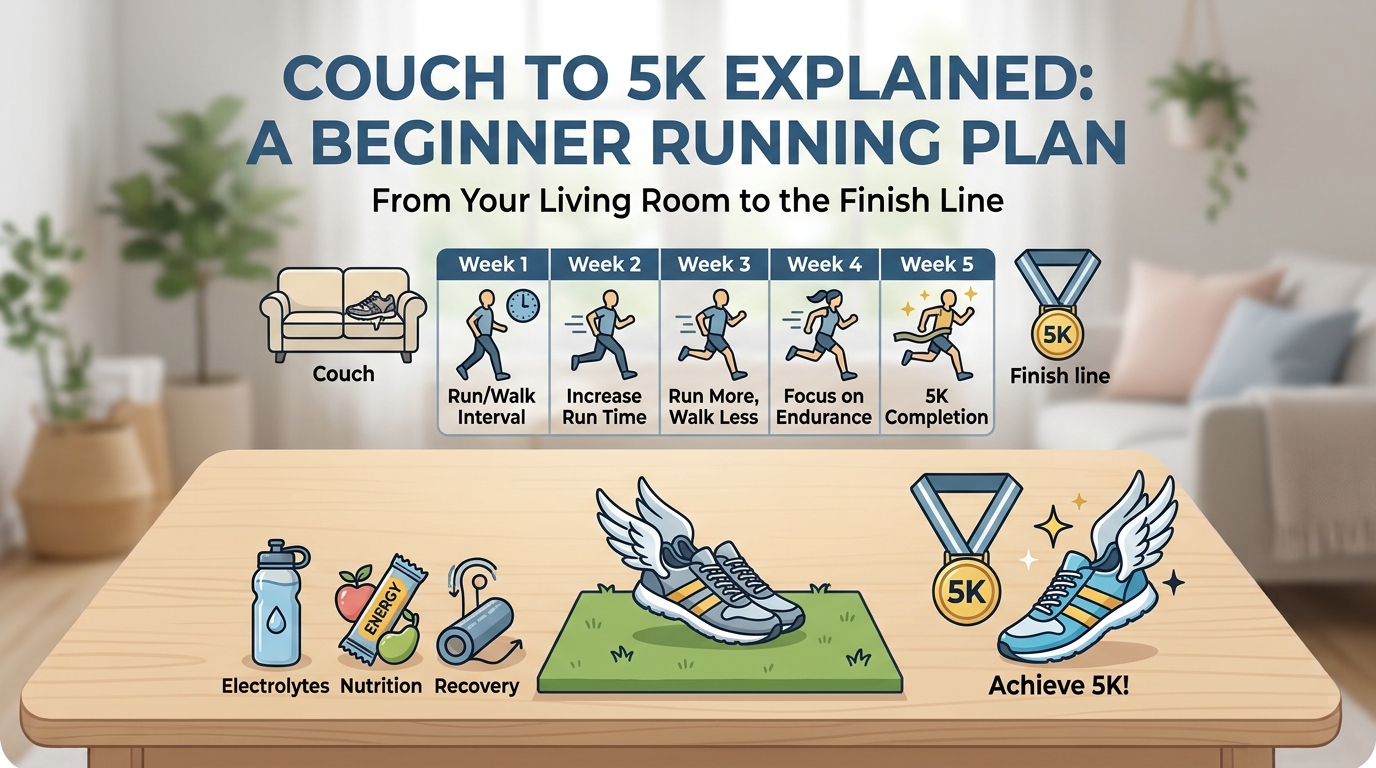
• Week 1 — Learn the run-walk rhythm: One-minute runs alternate with 90-second walks.
• Week 2 — Stay on your feet a little longer: Running intervals increase to 90 seconds.
• Week 3 — Try longer sections: Sessions combine 90-second and three-minute runs.
• Week 4 — Settle into five-minute efforts: Three- and five-minute runs become part of the workout.
• Week 5 — Make the first big jump: The week progresses toward one continuous 20-minute run.
• Week 6 — Build on that longer effort: Interval sessions lead to a 25-minute run.
• Week 7 — Find a steady rhythm: All three sessions are 25-minute runs.
• Week 8 — Add a small amount of time: Each session lasts 28 minutes.
• Week 9 — Complete the planned progression: Each session lasts 30 minutes.
Looking at Week 5 while you are still in Week 1 can make the plan seem more intimidating than it is. Pay attention to the session in front of you. The later workouts are meant for a body that has already completed several weeks of practice.
How Slowly Should You Run?
Slower than you might expect.
A classic first-run mistake is to make each jogging interval a hard effort. The runner makes it through the first few repeats before losing control of their respiration and concluding that the plan is beyond them. Pace is frequently the root of the problem.
Instead of sprinting, most early sessions should be conducted at a moderate jog. Your pace may be only slightly faster than a brisk walk. That is perfectly appropriate. You are learning to keep moving, not trying out for a race team.
The talk test provides a straightforward effort assessment. According to Centers for Disease Control and Prevention, a person working at a moderate intensity can speak but not sing. During intensive exertion, it becomes difficult to pronounce more than a few words without halting for breath. If you find yourself gasping before a brief interval, take it easy. Walking is also an acceptable answer; it is part of the workout and not a punishment.
What to Do When a Week Feels Too Hard
Repeat it.
That response can be disheartening when the strategy is presented as a clean nine-week schedule, but bodies do not always adhere to schedules. Sleep, work stress, weather, illness, menstrual cycles, prior activity, and running surface can all influence how a session feels.
I would repeat a week if I could only finish the workouts by pushing well beyond a controlled effort, if my running form failed prematurely, or if I was still unusually tired when the next session arrived. Repeating does not delete previous work. It offers the body another time to adjust to it.
If you miss several days, resume with the last workout that feels realistic. After a longer break caused by illness or injury, stepping back one or two weeks is often more sensible than trying to catch up. Never stack missed sessions together just to restore the original calendar.
A Weekly Schedule That Leaves Room for Recovery
Three running days do not mean three consecutive running days. A beginner schedule could look like this:
• Monday: Couch to 5K session
• Tuesday: Rest or an easy walk
• Wednesday: Couch to 5K session
• Thursday: Rest or a short strength session
• Friday: Couch to 5K session
• Saturday: Comfortable walking or another easy activity
• Sunday: Rest
Change the days around to fit your schedule. The important thing is to allow for recovery time between runs. Although your breathing may quickly return to normal after an exercise, muscles, tendons, bones, and joints take time to adjust to a new impact activity.
The CDC recommends that individuals do at least 150 minutes of moderate-intensity aerobic activity per week, or 75 minutes of intensive activity, with muscle-strengthening activities on two days. Treat it as a larger health goal rather than a chore to be fulfilled during your first week of jogging. Some action is preferable to none, and it can be increased incrementally.
Where Zone 2 Cardio Fits
Zone 2 cardio is also defined as continuous aerobic activity that feels sustainable and allows for discussion. The term sounds precise, but heart-rate zones on consumer watches are estimates, and fundamental formulas may not suit everyone.
A proficient runner may be able to jog with an effortless aerobic exertion. A true beginner may leave that effort range as soon as jogging begins. In such a case, brisk walking may be a preferable Zone 2 workout to try right now.
Do not hinder the learning process by attempting an exact watch reading. Combine breathing and perceived effort with the instrument. If a basic jog becomes tough, shorten the intervals or walk until your breathing improves. Your aerobic fitness can improve without every session having a
[Internal link: Beginner’s Guide to Zone 2 Cardio]
Do You Also Need 10,000 Steps a Day?
No. Ten thousand steps is a frequent target, but it is not required for Couch to 5K.
Walking is helpful, and short walks can make rest days less strenuous. The problem arises when a new runner adds three unfamiliar running sessions while simultaneously demanding a significantly increased daily step count. This added stress may be tolerable for one person but exhausting for another.
Keep your regular schedule in mind. If you already walk a lot at work, the running plan may be sufficient to increase your activity. If you’re mainly idle, a simple walk on non-running days will help you get moving without turning recovery into a workout. Heavy legs, increased discomfort, poor sleep, and decreased performance are all reasons to reduce the additional.
Shoes and Clothing: Keep the First Purchase Simple
You do not require a GPS watch, a collection of technical equipment, or the most expensive sneakers on the market. You will need footwear that is comfortable, secure at the heel, and has plenty of room around the toes.
Replace shoes that are overworn, unstable, or painful. If you are having trouble locating a comfortable pair, a reputable running store will let you try on different shapes and sizes. The best shoe isn’t necessarily the one with the most cushioning or the highest price; it’s the one that fits your foot and feels good to wear.
Dress in weather-appropriate clothing that won’t rub. A supportive sports bra can make running much more comfortable. If you’re jogging near traffic or in low light, use fluorescent clothing and choose a well-lit route. Headphones should never interfere with your ability to see automobiles, bikers, dogs, or other people around.
A phone timer is adequate for simple intervals. If you prefer aural cues and don’t want to stare at the clock, a guided Couch to 5K app is a great choice.
Warm up without doing another workout.
NHS sessions begin with a five-minute walk. Use it to gradually transition from rest to exercise. Begin slowly and progressively increase your speed as you warm up.
Maintain a forward-facing gaze and relaxed shoulders while running. Allow your arms to swing naturally. Avoid reaching too far forward with each step; most beginners prefer a shorter, more comfortable stride. There’s no reason to mimic a quicker runner’s form or make significant alterations when you’re still figuring out what feels correct.
Finish with another five-minute stroll. After that, drink as needed, eat your regular meals, and give yourself some rest before your next run. The majority of quick starting sessions do not necessitate the use of specific recovery drinks or supplements.
Strength Training That Supports Running
One or two short strength training sessions each week can help a beginner’s running program. Keep things simple at first. Chair squats, glute bridges, calf raises, step-ups, rows, and wall or slope push-ups are more than just a complicated collection of “runner-specific” exercises.
Begin with a small amount and perform the actions properly. A strength session that makes it difficult to walk downstairs is not an ideal preparation for a planned run. I’d rather see a beginner do 15 controlled minutes on a consistent basis than attack a large workout once and then avoid it for two weeks.
Strength training does not guaranty an injury-free running career, but it can help increase overall capacity and complement the activity guidelines. Increase resistance only when the technique
[Internal link: Beginner Dumbbell Workout for Full-Body Strength]
Normal Soreness or a Sign to Stop?
New exercise might cause modest soreness in the calves, thighs, and hips. This type of muscular soreness usually comes later, feels dispersed throughout a muscle rather than sharply focused in one area, and improves over time. It should not make you limp or modify the way you walk.
Sharp pain, escalating pain, apparent swelling, pain that alters your stride, or discomfort that persists during typical everyday activity warrants more caution. If your symptoms are severe, persistent, or recurring, stop running and consult a trained healthcare expert. Trying to push through pain that becomes worse with each step is ineffective training.
Stop exercising immediately and get medical attention if you have chest tightness or pain, fainting, extreme dizziness, or unusual shortness of breath. According to the American Heart Association, probable heart-attack warning signals include chest discomfort, pain or discomfort in the arms, back, neck, jaw, or stomach, and shortness of breath. Emergency instructions vary by country; if warning signs appear, contact your local emergency services.
Running in Public When You’re Self-Aware
Most people pay much less attention than a concerned new runner may imagine. Knowing this does not always relieve the pain.
Choose a quieter route, travel at a less congested time, use a treadmill, or bring a supportive friend. A circle near your home can make you feel safer because you can always stop if you need to. Audio-guided intervals give you something specific to focus on.
Walking while jogging is natural. It is part of the Couch to 5K program. You don’t have to hide your stroll breaks or accelerate as someone passes. Other runners are following their workouts, whilst you are doing your own.
Treadmill or outdoors
Both work out. A treadmill has a consistent surface, controlled speed, and is an indoor option during bad weather. For the great outdoors your run is varied with natural changes in pace, curves, wind, and the ground.
On a treadmill, pick run speed which matches your planned work rate not a set which you think is equal to real running. Use the bars only for safety. For outdoor run pick a route with safe cross traffic, good lighting, and a surface that you are sure footed on.
You may also put the two together. Doing Monday’s workout at the treadmill and Friday’s at the park doesn’t derail the plan.
Frequently Asked Questions
I’ve never run before. Can I do Couch to 5k?
Yes. The program is geared for beginners and begins with short running intervals followed by walks. If Week 1 is too taxing, start with comfortable walking and shorter jogs before attempting it again. If you have any health concerns or an existing disease that may interfere with your ability to exercise, consult a healthcare practitioner first.
How many days per week should a beginner run?
The NHS plan consists of three running days per week, with rest days in between. A newbie does not need to run every day. Consistent sessions with enough recuperation time are more beneficial than adding days before the body is ready.
Is it okay to walk in a 5K?
Of course but do check the rules and time frames for each event. Many folks do their first 5K with run-walk breaks. Walking doesn’t reduce the distance at all.
May I do Couch to 5K on the treadmill?
Yes. Use proper walking and running paces, pay attention as you change pace, and don’t compare your settings to what other runners use. Also the NHS puts forward treadmill running as a choice for people who prefer not to run outdoors.
Couch to 5K may not only help you in that regard.
It may see an increase in activity which in turn promotes health but also bear in mind that weight is a result of food intake, sleep, health issues, medication, stress and many other variables. The program does not guarantee weight loss. If weight management is your main goal we recommend you to seek out the advice of a health care professional or registered dietitian.
What to do if I miss a week?
Return to the present which you are at. After a short break you may jump back in where you left out, but illness, injury, or a long absence may require you to do an earlier week all over again. Do not try to make up for multiple missed runs in a few days.
What if at week nine I can’t run for 30 minutes?
Repeat again the same week or go back to the previous interval schedule. We have a 9 week timeline which does not include a drop deadline. Better recovery, longer and more flexible intervals, and the confidence to train more are signs of improvement.
Your first go is to be repeatable
The greatest first session isn’t always the one with the quickest pace. It’s the one you can complete without making the last interval a struggle or dreading the next session.
Select 3 which are convenient for you, plan a safe route and at first try a five minute walk. At the start of your run note how you feel and run at a pace that you can maintain. The quiet phase is when the strategy takes off.