

Maya bought a retinol serum after seeing it in almost every skincare video on her phone. The label promised smoother, younger-looking skin, so she used it every night. Within a week, her face felt dry, red, and sore. She thought the product was bad, but the real problem was how she used it. Like many people, Maya did not know the difference between retinol vs retinoid, which strength suited her skin, or how slowly she needed to begin. If these names also confuse you, here is the simple answer.
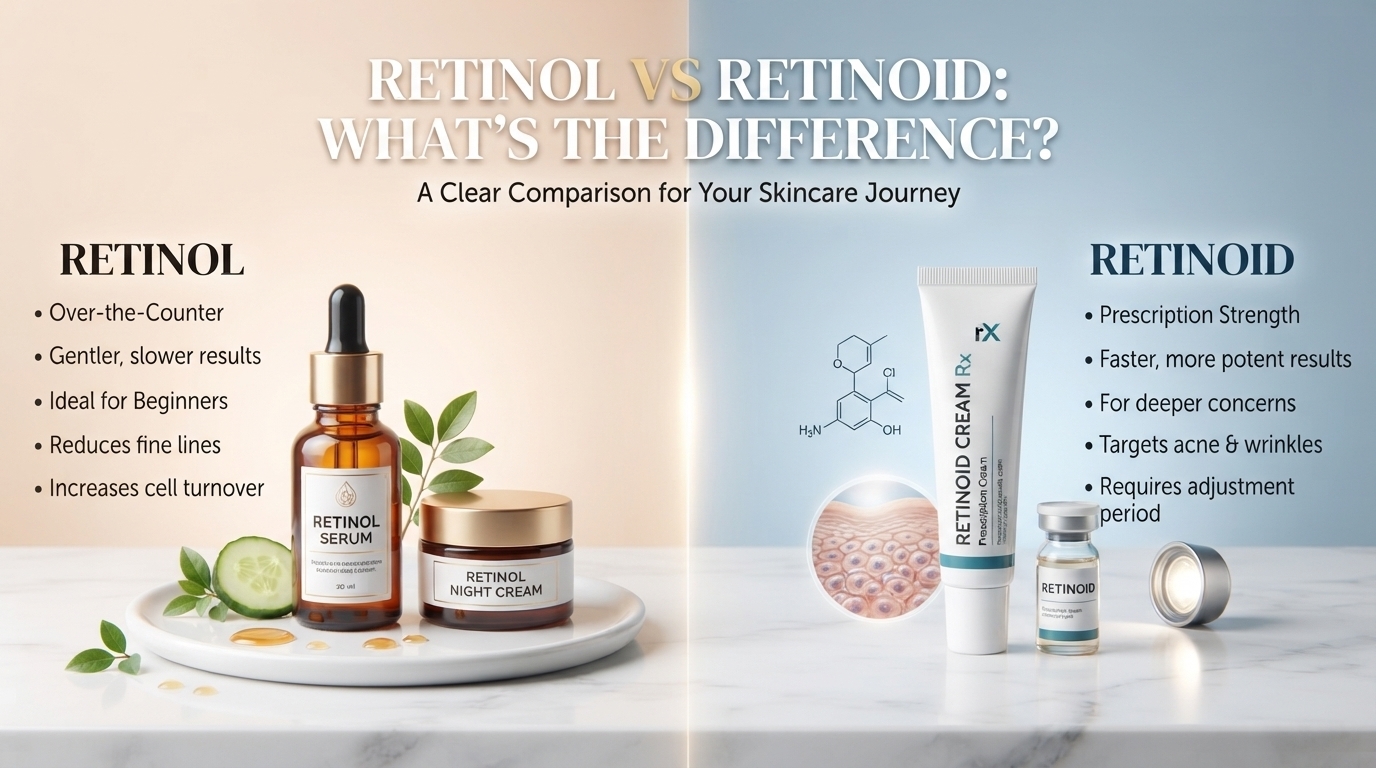
Retinoid is the name for a group of vitamin A ingredients. Retinol is one member of that group. Retinol is usually gentler and sold without a prescription, while prescription retinoids such as tretinoin are often stronger, work more directly, and may cause more irritation.
Medical note: This article provides general skincare information and does not replace advice from a dermatologist or another qualified healthcare professional.
The Difference in One Simple Sentence
All retinol products are retinoids, but not all retinoids are retinol.
“Retinoid” is an umbrella term for several vitamin A ingredients used in skincare and medicine. These include retinol, retinal, adapalene, tretinoin, tazarotene, and trifarotene.
Retinol must change inside your skin before it reaches retinoic acid, the form that skin cells can use. Prescription tretinoin is already retinoic acid, so it does not need the same conversion process. That does not mean retinol is useless. It simply tends to work more gently and slowly.
Retinol vs Retinoid at a Glance
Let’s us understand with the help of comparison table that how Retinol and Retinoid is different from each other.
| Feature | Retinol | Prescription Retinoids |
| Product type | A type of retinoid | Stronger vitamin A medicines |
| Where to get it | Usually sold over the counter | Usually requires a prescription |
| Common uses | Fine lines, uneven tone and mild texture problems | Acne, sun damage, wrinkles and pigmentation |
| Strength | Usually gentler | Usually stronger and more direct |
| Speed | Results may take longer | May produce changes sooner |
| Irritation risk | Lower, but still possible | Often higher |
| Best for | Beginners and people with mild concerns | People needing stronger, medically guided treatment |
There are exceptions. For example, adapalene 0.1% is available without a prescription in the United States, although other strengths and retinoids may still require one. Access rules can differ in the UK and Canada, so ask a pharmacist or clinician if you are unsure.
What Do Retinoids Actually Do?
Retinoids affect how skin cells grow and renew. Depending on the ingredient, they may help prevent clogged pores, improve uneven tone, soften fine lines, and support collagen in the skin.
The American Academy of Dermatology explains that retinoids can help with mild acne, mild pigmentation problems, and fine lines. Tretinoin was approved as an acne treatment in the United States in 1971, so retinoids are not a new social-media trend. American Academy of Dermatology
However, one product cannot fix every skin concern. Retinoids do not replace sunscreen, moisturizer, medical acne care, or treatment for skin conditions such as eczema and rosacea.
Which Retinoid Is Which?
The names become easier to understand when you see how the common options differ.
Retinyl Esters
Retinyl palmitate and retinyl acetate are mild vitamin A forms used in some cosmetic products. They require more conversion steps inside the skin, so they are usually less active than retinol.
They may suit someone who wants a very gentle starting point, but evidence for visible anti-aging results is not as strong as it is for tretinoin.
Retinol
Retinol is widely used in over-the-counter serums and creams. It must convert first to retinal and then to retinoic acid.
This slower path can make retinol easier to tolerate, but it also means you may need to use it regularly for several months before judging the result.
Retinal
Retinal, also called retinaldehyde, sits one conversion step away from retinoic acid. It may work faster than retinol while still being available in cosmetic skincare products in many markets.
Do not assume that all retinal products are the same. Full formula, concentration, packaging, and frequency of use will vary which in turn will vary how your skin reacts.
Adapalene
Adapalene is a retinoid that is used topically for acne. In the U.S. 0.1% adapalene is available without a prescription. It also helps to prevent pores from clogging and reduce new breakouts. It is not what a stronger retinol serum is. This is a medical solution for acne.
Tretinoin
Tretinoin is a prescription form of retinoic acid. In the field of dermatology it is used for acne and also put forward as a treatment for signs of sun damaged skin. Research report it improve sfine and coarse facial wrinkles from sun damage. In a recent review of eight trials which included 1,361 people we see that topically applied tretinoin did better in improvement of facial photoaging as compared to a non-active base treatment. PubMed review of which also included a study of that. Tretinoin also causes dryness, peeling, redness and burning which is to be expected in the first few weeks.
Tazarotene and Trifarotene
These include prescription topical retinoids which we use for acne and also note that Tazarotene has other applications in dermatology. They do not go in for what the influencers say about which products are the best. A dermatologist is the one to see for what products will work for you and if the benefits they bring outweigh the irritation risk.
Retinol vs Retinoid: Which one is for you?
Choose what is gentlest yet still effective for your issue. You can’t see results with the most powerful product. A product only does what it is supposed to if you use it safely and regularly.
Start with Retinol if you are a beginner.
At over the counter retinol is a good first option for which of the following:
• Mild fine lines
• Slightly uneven skin tone
• Rough texture
• Mild pigmentation
• Skin which has never used a retinoid.
Choose a mild formulation and start slow. The AAD suggests going with the weakest option available and to begin which is to use it every other night. For very sensitive skin we may get by with twice a week at first.
Ask About Adapalene for Mild Acne
If you are dealing mostly with clogged pores and breakouts a product like adapalene may be a better choice than a cosmetic anti-aging serum.
See a dermatologist if your acne is severe, leaves marks, associated with hormonal changes, or is resistant to home care. Trendy serums are not a substitute for professional acne treatment.
Try a Prescribed Retinoid for more intensive treatment.
A dermatologist may prescribe tretinoin or some other retinoid for:
• Regular or stubborn acne
• Clear signs of sun damage
• More noticeable fine lines
• Irregular pigmentation which has not improved.
• A need for a care plan that includes medical follow up.
Prescription does not mean “for all”. It means the treatment requires more care in its choice and application.
Best for your skin type
Your skin type is a guide but it isn’t the end of the story.
Oily Skin
Oily skin can do well with adapalene or some other acne specific retinoid but oil itself does not protect you from irritation. Go for a light non-comedogenic moisturizer and also avoid the use of many drying acne products at the same time.
Dry Skin
Dry skin usually requires a mild retinol cream as opposed to a heavy gel. Put on your moisturizer either before or after the retinoid to reduce dryness. If your skin is already damaged or dry, repair the skin barrier first.
Combination Skin
You don’t have to cover up your whole face. If you have sensitive cheeks but an oily forehead and chin, see a pro if a targeted, area based routine is right for you. Use little of it. In oily areas adding more product will not speed up the process.
Sensitive Skin
Sensitive skin may react even to low-strength retinol. Patch-test the product and begin once or twice a week.
People with eczema, rosacea, strong redness, or an already damaged skin barrier should speak with a dermatologist before trying a retinoid. The AAD notes that people with significant redness or inflammation may need another treatment instead. AAD retinoid guidance
Acne-Prone Skin
Choose a product made to treat acne rather than buying the most popular anti-aging cream. Adapalene has an established role in acne care, while severe, painful, or scarring acne needs medical attention.
A temporary increase in small breakouts can happen when starting some acne treatments, but do not call every bad reaction “purging.” Burning, swelling, severe itching, or worsening rash may mean irritation or an allergy.
Skin of Color
Retinoids can benefit all skin tones. However, irritation may leave dark marks on deeper skin tones. Starting slowly, moisturizing well, and stopping before irritation becomes severe can lower this risk.
Is Retinol Worth Using for Wrinkles?
Yes, retinol is worth using for wrinkles. It can help improve fine lines and signs of sun damage, but results are gradual and vary between products.
A 2025 network meta-analysis of 23 controlled trials with 3,905 participants found that retinol and certain prescription retinoids improved fine wrinkles. The researchers also noted differences in results and side effects between treatments. Scientific Reports
Tretinoin has stronger and longer-standing evidence for photoaging, but it also tends to cause more irritation. A review comparing tretinoin with other topical treatments described tretinoin as a leading treatment for photoaging while noting that poor tolerance can limit its use. American Journal of Clinical Dermatology
Retinol cannot erase deep wrinkles, replace lost facial volume, or undo years of sun exposure. Sunscreen remains essential because continued ultraviolet exposure works against your anti-aging routine.
Can Retinoids Help With Ingrown Hair?
Yes, Retinoids can help with ingrown hair. A prescription retinoid may help some people with recurring ingrown hair, especially a condition called pseudofolliculitis barbae. This happens when shaved or plucked hair curves back into the skin and causes inflamed bumps.
Tretinoin may help clear dead surface cells that can trap hair. However, it does not fix poor shaving technique, and it may irritate skin that is already inflamed. Mayo Clinic lists prescription retinoid cream as one possible treatment while also recommending a break from shaving, tweezing, or waxing until the skin improves. Mayo Clinic
If bumps contain pus, feel painful, leave scars, or keep returning, ask a healthcare professional for help. Do not place a strong facial retinoid on recently waxed or broken skin.
[INTERNAL LINK NEEDED: How to prevent and treat ingrown hairs]
Can You Buy Retinol Without a Prescription?
Yes. Retinol is normally sold over the counter in serums, creams, and lotions.
However, an over-the-counter label does not mean the product cannot irritate your skin. Cosmetic retinol products also vary greatly in their formulas. The percentage may not always be clearly shown, and two products with the same stated percentage may not perform in the same way.
In the United States, adapalene 0.1% is another over-the-counter retinoid option, mainly for acne. Tretinoin, tazarotene, and trifarotene generally require prescriptions.
Rules and product categories are not identical in the USA, UK, and Canada. Check local packaging and ask a pharmacist rather than assuming advice from a foreign social-media video applies to your country.
How to Begin Without Hurting Your Skin
A slow start gives your skin time to adjust.
Use it at night. Clean your face with a gentle cleanser and pat it dry.
Wait until the skin is dry. Applying a retinoid to damp skin can increase how quickly it enters the skin and may increase irritation.
Use a pea-sized amount. This is normally enough for the whole face. More product does not create faster results.
Avoid delicate areas. Keep it away from the eyelids, corners of the nose, lips, and broken skin unless your clinician gives different directions.
Begin two nights a week. If your skin remains comfortable for a few weeks, slowly increase the frequency.
Add moisturizer. You can apply moisturizer before the retinoid, after it, or both. This “sandwich” method may help dry or sensitive skin.
Wear sunscreen every morning. Use broad-spectrum SPF 30 or higher and follow the label for reapplication. The AAD recommends daily sun protection while using retinoids.
A simple night routine could be:
Gentle cleanser → moisturizer → retinol or retinoid → moisturizer
You do not need six serums around it.
[INTERNAL LINK NEEDED: Correct skincare routine order]
What Should You Avoid on Retinoid Nights?
During the first few weeks, avoid using several strong active ingredients in the same routine.
Strong alpha-hydroxy acids, beta-hydroxy acids, facial scrubs, and high-strength acne products may add to dryness and irritation. This does not mean these ingredients can never be used together. Some prescription acne treatments combine a retinoid with other active ingredients, but the formula and schedule are selected carefully.
If you already use salicylic acid for blackheads or benzoyl peroxide for acne, ask a pharmacist or dermatologist how to separate the products. You may use one in the morning and the retinoid at night, or alternate nights.
[INTERNAL LINK NEEDED: Safe skincare ingredients and combinations]
Why Some Viral Retinol Products May Not Help You
A viral product does not guarantee to be effective or safe for your skin.
Here is the care you should take with these common marketing issues:.
A large percentage of the front label
A greater quantity may include a retinol complex which isn’t the same as pure retinol. Check the full ingredient list and the brand’s description before you compare numbers.
“Medical-Grade” Claims Without Clear Details
A clinical look to the bottle doesn’t mean the product is a prescription medicine. We see into a clear presentation of the active ingredient, proper packaging, labels, and proof of the finished formula.
Retinol Alternatives That Contain No Retinoid
Some plants’ extracts and what we term bio-retinol may moisturize or benefit the skin but they do not in any way measure up to retinol or tretinoin. That doesn’t mean they are not useful just that their action is different.
Expensive Packaging With Weak Protection
Retinol breaks down with exposure to light and air. For storage use of a dark opaque pump or tube which is also well sealed instead of a clear open jar.
Products which got viral
Light out, camera tools, make up, skin hydration, and editing what you see. What you get in terms of improvement in wrinkles and pigmentation is from consistent care not3 nights.
Choose what works for your skin issue, not trends.
When To Seek Out Help?
Mild dryness or some flaking may occur at first. Severe pain, swelling, blisters, crusting, or a very bad rash is not a thing you should push through.
Stop use of the product and see a professional if:
1. Your face will be red for a long time after application.
2. Redness or peeling becomes severe.
3. Your acne is becoming painful and is also starting to scar.
4. Dark spots appear due to repeat irritation.
5. You are a subject of eczema, rosacea, or some other present skin issue.
6. You do not know if any other drugs interact with your current medication.
Do Not Use Retinoids During Pregnancy
The American Academy of Dermatology reports that you should stay off of all forms of retinoids which are both prescribed and over the counter products with retinol during pregnancy. If you are pregnant, trying to get pregnant, or think you may be pregnant at all, stop use and see your obstetrician or dermatologist for personal advice. AAD pregnancy skin care info.
Breastfeeding tips may vary by product and site of application. Consult your health care provider before resuming retinoid.
Frequently Asked Questions
How soon will I see results of retinol?
In some cases we see changes in texture after a few weeks, for fine lines and pigmentation you may have to wait a few months which is a result of consistent use. What the product’s formula, strength, how often you use it, what skin issue you are addressing and sun protection all play a role in that.
Is prescription tretinoin better than retinol?
Tretinoin is a more direct treatment and has more research to support its use for acne and photoaging. However it does cause more irritation. Retinol may be the better option for you if you have only mild issues or you are not tolerant of tretinoin.
Can I use retinol every night?
Some people may see results as their skin adapts, but daily use isn’t necessary to start out. Begin a few times a week and slowly increase the frequency only if your skin is still tolerant. Follow the prescription directions closely if you are using a medical retinoid.
Does retinol make skin thinner?
Retinoids also bring out peeling and dryness at the start which in turn may cause the skin to appear thin or fragile. In the long term they promote collagen support and improvement of signs of photo aging. Severe peeling is a sign of irritation but not that the product is in fact working.
Can teenagers use retinoids?
A teen that has acne may be put on adapalene or some other retinoid. Also it is not true that young people require anti-aging products just because they are popular on the internet. Parent, pharmacist, or clinician input is recommended in the choice of acne treatment when it is needed.
Should I use retinol for blackheads?
Retinoids do well in preventing clogged pores which includes the plugs that form blackheads. As for blackheads related to acne, adapalene may be a better option than a cosmetic anti-aging serum. Introduce it slowly and avoid squeezing pores.
Can you use vitamin C with retinol?
Some people put on vitamin C in the morning and retinol at night. This rotation which also lessens the chance of irritation and at the same time simplifies the routine. Also if your skin is sensitive introduce one active product at a time.
Choose what your skin will tolerate
In fact the main issue between retinol and retinoid is that they are not black and white. Retinol is a mild member of the retinoid group, but as for tretinoin which is used in medicine; it goes in at a much stronger level and requires more care.
If you have mild fine lines or even out of texture, start with a gentle over-the-counter retinol. If you have persistent acne, deep sun damage, or a issue that returns, see a dermatologist for a prescription option. Start slow, use a moisturizer, protect your skin from the sun, and give it time over months which are better than days.