

The Science Behind One of Their Most Fascinating Sounds
By Dr. Elena Marquez
Veterinarian & Feline Health Writer
Dr. Elena Marquez is a veterinarian and feline health writer who specializes in feline behavior and everyday cat health. She translates veterinary and animal-behavior research into practical information that helps cat owners understand what their pets are communicating. Her goal is to explain common feline behaviors clearly while helping readers recognize when a change in behavior may deserve professional attention.
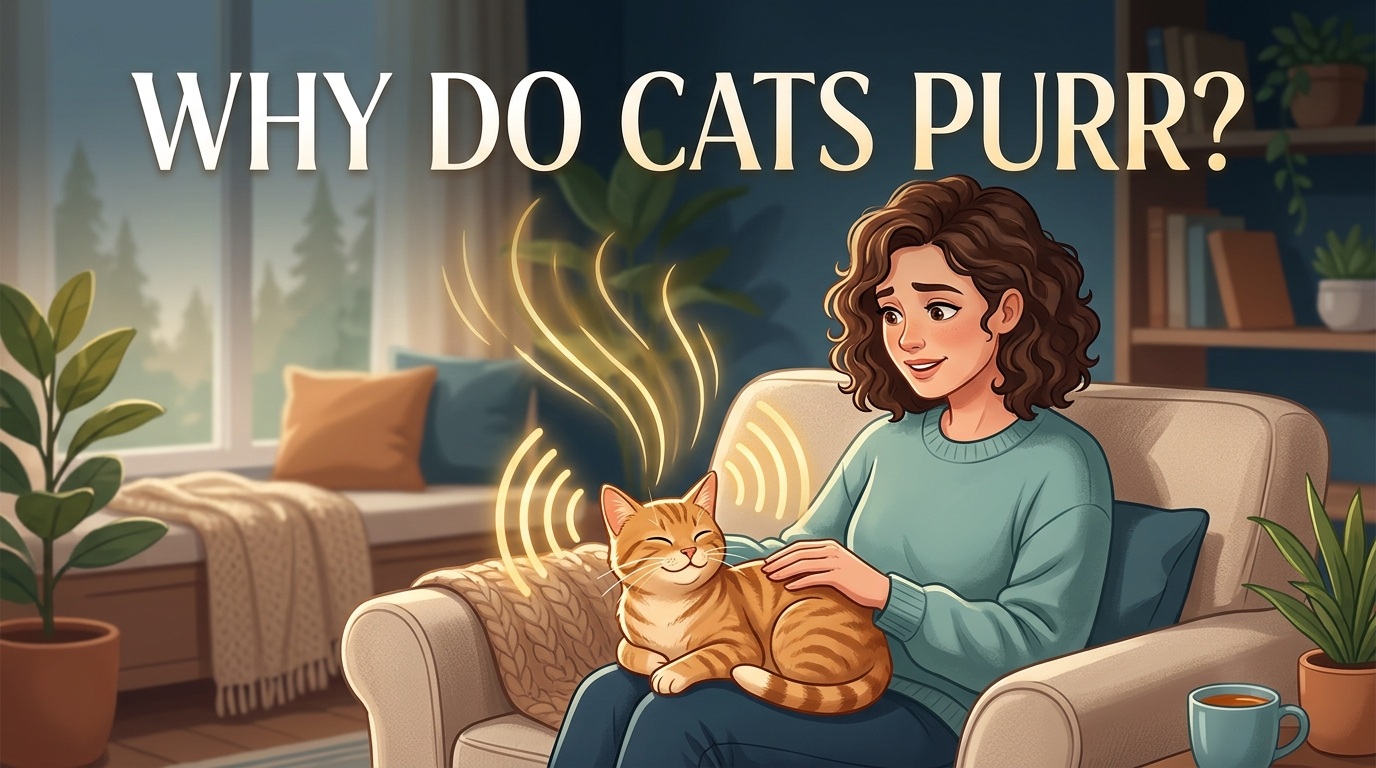
You are sitting on the couch when your cat climbs beside you, settles against your leg, and starts making that familiar little vibration. It is easy to interpret the sound as a simple feline “I’m happy,” but why do cats purr? The science is more interesting than that answer suggests. Cats can purr during relaxed social interactions, but purring can also occur in other situations, including stress or illness, so the sound needs to be interpreted alongside the rest of the cat’s behavior. Cats Protection
How Do Cats Actually Produce a Purr?
A cat’s purr is a low-frequency, repetitive vocal sound produced around the larynx, or voice box. For decades, explanations of purring often focused on the idea that specialized muscles in the larynx actively contract and relax at a regular rhythm. Earlier physiological research investigated neural and muscular mechanisms involved in feline purring, which helped establish the idea that the nervous system and respiratory system play roles in the behavior. PubMed
But present research has put forth a more complex — and also more interesting — picture. In a 2023 study which appeared in Current Biology researchers looked at the larynges of eight domestic cats which they had removed. All eight produced self-sustained oscillations in the normal purring range without any neural input or active muscle contraction. The researchers reported base frequencies of 25 30 Hz which they put forth that special tissue in the vocal folds may explain how cats produce very low frequency sounds. PubMed.
That study reports on the basic assumption which a cat has to constantly “turn on and off” its laryngeal muscles to produce each purr vibration. We did not see that active muscle control is out of the question. Instead we report that the cat’s larynx’ physical structure may in fact be what produces purr like vibrations which may at the same time be augmented by active neuromuscular control. PubMed
Why the mechanism is still being debated
Purring is unusual because it can continue during both inhalation and exhalation, producing the characteristic steady vibration owners recognize. Researchers have studied the neural, muscular, respiratory, and mechanical components of this behavior for decades, but the exact biological pathway is still an active area of research. PubMed
So if you have read that cats purr because of a single special “purring muscle” or a precisely identified brain oscillator, treat that explanation cautiously. Current research supports a more complicated picture.
Why Do Cats Purr?
There is no single emotional meaning attached to every purr.
Cats may purr during situations involving:
- Positive social contact
- Feeding or anticipation of food
- Relaxation
- Attention-seeking
- Stress
- Fear
- Discomfort or pain
The context matters.
A cat curled comfortably on your lap with relaxed muscles and soft eyes is giving you a very different collection of signals from a cat crouched under furniture, refusing food, and purring unusually loudly.
That is why veterinarians and animal behavior experts look at the whole behavioral picture, rather than using purring as a stand-alone diagnostic clue.
Does My Cat’s Purr Actually Mean They’re Happy?
Sometimes—but not always.
A relaxed cat may purr while being stroked, sitting beside a trusted person, or settling down for a nap. In those situations, purring can occur alongside other signs of comfort, such as a loose body, relaxed ears, normal appetite, and willingness to interact.
But purring itself does not prove that a cat is happy.
Cats Protection, a UK feline welfare organization, notes that cats can purr when they are content but may also purr when stressed or in pain. It recommends paying attention to changes in the cat’s normal behavior and body language. Cats Protection
A useful rule for owners
Don’t ask only, “Is my cat purring?” Ask, “What else is my cat doing?”
For example:
| Situation | Purring may fit with |
| Relaxed body, slow blinking, seeking attention | Contentment or social interaction |
| Kneading while resting beside you | Comfort or affiliative behavior |
| Hiding, tense posture, ears held back | Stress or fear |
| Purring with reduced appetite and unusual inactivity | Possible illness or discomfort |
| Purring after an injury or procedure | Possible self-soothing or discomfort |
This table is a guide, not a diagnostic tool. The same sound can occur in different emotional states.
Why Do Cats Purr When You Pet Them?
Many cats purr during gentle petting because social contact can be rewarding and calming.
If your cat approaches you, settles down voluntarily, relaxes its body, and begins purring while you stroke it, the behavior is consistent with a comfortable social interaction.
Some cats will also knead blankets, your clothing, or your lap while purring.
Kneading and purring commonly occur together during relaxed interactions, but the exact meaning can vary between individual cats.
Your cat may also learn that purring gets a response from you. If purring reliably leads to petting, food, attention, or another desirable interaction, the behavior can become part of the cat’s communication with its human household.
Why Do Kittens Purr?
Kittens can begin purring very early in life.
One practical reason is communication.
Newborn kittens are vulnerable and have limited mobility, so close-range communication with their mother is particularly useful. Purring can occur during nursing and other close interactions.
Adult cats also use a wide range of vocalizations and body signals to communicate with people and other cats.
Purring is therefore not simply an emotional “smile.” It is part of a broader communication system that includes:
- Vocal sounds
- Ear position
- Tail movement
- Body posture
- Facial expression
- Touch and proximity
Understanding those signals together gives owners a much better picture of what their cat may be communicating.
Why Does My Cat Purr and Knead?
If your cat climbs onto a blanket, starts kneading with its paws, and begins purring, you are probably seeing a familiar comfort-associated behavior.
Kneading involves rhythmically pushing the front paws against a soft surface. Many cats display it when they are relaxed.
The behavior is often associated with kittenhood because kittens knead around the mother’s mammary area while nursing. However, adult cats may continue kneading as part of comfortable or familiar routines.
There is no need to stop normal kneading simply because it looks unusual to humans.
If the claws are uncomfortable, place a thick blanket between the cat and your skin rather than punishing the behavior.
Can a Cat Purr When They’re Sick or in Pain?
Yes. A cat can purr while experiencing stress, discomfort, or pain.
This is one of the most important misconceptions for owners to understand.
A purring cat is not automatically a healthy or pain-free cat.
Cats Protection specifically notes that purring can occur when a cat is in pain and recommends veterinary assessment when a cat’s purring increases significantly or occurs in situations that are unusual for that individual cat. (Cats Protection)
This does not mean that every purring cat is secretly sick.
It means purring should be interpreted with context.
What Might Pain Look Like in a Purring Cat?
Cats can be difficult to assess because they may show relatively subtle behavioral changes when uncomfortable.
A 2016 expert-consensus study identified 25 behavioral signs considered sufficient to indicate pain in cats, although no single sign was considered necessary for every painful condition. PubMed
Possible changes can include:
- Reduced activity
- Changes in posture
- Reduced grooming
- Hiding
- Changes in appetite
- Reluctance to move
- Unusual aggression or withdrawal
- Changes in normal social behavior
Research on feline chronic pain also emphasizes that behavioral changes are important because cats may not display pain in an obvious way. PubMed
So if your cat is purring but suddenly stops jumping onto furniture, spends more time hiding, eats less, or seems unusually quiet, don’t let the purring reassure you that everything is fine.
How Can You Tell a Happy Purr From a Stressful Purr?
There is no reliable “happy purr versus pain purr” decoder that works for every cat.
Instead, look at the surrounding signals.
A relaxed cat may show:
• Loose muscles
• Normal movement
• Relaxed ears
• Normal appetite
• Comfortable interaction
• Familiar sleeping behavior
A stressed cat may show:
• Hiding
• Crouching
• Tense posture
• Reduced interaction
• Changes in appetite
• Unusual vocal behavior
• Changes in grooming
• Reluctance to move
Your cat’s atypical behavior
If your cat has always had loud purrs in your lap, by all means that is normal. But if the same cat starts to constantly purr out of the blue while hid under the bed and also stops eating that is a different context which requires more attention.
Why Might a Cat Purr When Frightened?
Purring does not necessarily require a calm environment.
Cats Protection notes that purring may occur during stressful situations as well as comfortable ones. Cats Protection
One possible interpretation is that purring can form part of a cat’s self-regulatory or self-soothing behavior, although claims about exactly why cats do this remain less certain than the basic observation that purring can occur in stressful contexts.
For example, a cat might purr while:
- Visiting a veterinary clinic
- Being handled
- Recovering from an injury
- Facing an unfamiliar environment
The important point is not to assume the cat is enjoying the situation simply because it is purring.
Does Purring Heal Cats?
You may have encountered claims that a cat’s purr can heal bones, repair tissue, or reduce pain because of its low-frequency vibrations.
There is a real scientific basis for interest in the physical properties of purring, but the popular claims often go much further than the evidence allows.
Cats Protection describes the idea that low-frequency vibrations could promote bone and tissue growth or lessen pain and swelling as a suspected function rather than an established medical treatment. Cats Protection
That distinction matters.
There is currently no good basis for telling an owner that a cat’s purring will medically heal an injury or replace veterinary treatment.
If a cat is injured, purring should never be used as evidence that veterinary care is unnecessary.
Why Do Cats Purr More Around People?
Cats can use purring as part of their interaction with humans.
A domestic cat may learn that certain sounds or behaviors produce a response from its owner.
For example, your cat may begin purring when you:
- Open a food container
- Sit on the couch
- Reach toward it
- Start petting it
- Prepare for bedtime
The behavior may therefore become part of an established human-cat routine.
This does not mean the cat is deliberately “manipulating” you in a negative sense. It simply means behavior can be shaped by what happens after it.
If purring is consistently followed by attention or food, it can become a useful communication behavior.
Why Does My Cat Purr While Sleeping?
A cat may also be found purring while in sleep.
If the cat is at ease and there are no other issues, what you may see is normal purring while she is at rest. It isn’t something that requires emergency attention.
Cats sleep for great stretches of the day which is why you may see a lot of everyday cat behaviors while they are dozing.
If purring during rest is a recent issue, very frequent, or at the same time you notice breathing difficulties, agitation, reduced appetite, or other behavioral changes, see a vet.
The key is in what symptoms present, not in the purr by itself.
Do All Cats Purr?
No.
Purrs are very common but it is true that each cat’s habit may vary.
Cats Protection reports that not all cats purr.
Some cats prefer to keep to themselves which they do through body language and facial expressions as well as other means of communication.
A cat that doesn’t purr often is not necessarily unhappy.
Also it is not true that a cat which purrs a lot is also very healthy and happy.
When Should You Be Concerned About Your Cat’s Purring?
A sudden change is more meaningful than a consistently established habit.
Consider contacting your veterinarian if your cat begins purring in unusual situations and you also notice other changes such as:
- Hiding more than usual
- Eating or drinking differently
- Difficulty moving
- Changes in grooming
- Unusual aggression or withdrawal
- Persistent restlessness
- Changes in litter-box behavior
- Obvious injury
- Difficulty breathing
Feline pain can be subtle, and veterinary guidelines emphasize the importance of recognizing behavioral changes when assessing discomfort. PubMed
A simple decision rule
Normal purring + normal behavior = usually observe.
New purring + major behavior change = investigate.
Purring + obvious illness, injury, breathing difficulty, or severe discomfort = contact a veterinarian promptly.
Common Myths About Cat Purring
Myth: Every purring cat is happy
Not necessarily. Purring occurs during positive interactions, but cats may also purr during stress or pain. Cats Protection
Myth: A purring cat cannot be in pain
False. Purring can occur alongside pain, so owners should watch for changes in posture, activity, appetite, grooming, and behavior. PubMed
Myth: Scientists completely understand how cats purr
Not quite. The physical mechanism has been studied for decades, and 2023 research challenged some long-standing assumptions about the role of active laryngeal muscle contractions. PubMed
Myth: A cat’s purr can heal an injury
Not established. Low-frequency vibrations are an interesting area of research, but owners should not treat purring as a medical therapy. Cats Protection
Frequently Asked Questions
Why do cats purr?
Cats purr as a means of communication which they do at times of relaxation and social interaction, while also reported at times of feeding, stress and what may be construed as discomfort. As to the biology of it, we are still in the process of learning. What we do know from present research is that the feline larynx is able to produce purring frequency vibrations without input from the nervous system which challenges the older theories which stated that it was a result of muscle activity.
Does your cat only purr when they are happy?
No. A cat that is at ease may purr while petting, and when at rest, but also a cat may purr during stressful of painful times. It is best to go by the whole of the cat’s behavior for what is normal, that is to look to posture, appetite, activity, face expression as well as if anything is out of the ordinary.
Do cats purr in pain?
Yes. Purring is a behavior which maybe a response to pain or discomfort in cats. A cat that is usually purring but then begins to hide out, stop eating, move different, groom less or behave out of character is not to be assumed to be doing fine just because it is still purring. At the first signs of such changes a vet visit is recommended.
Why do I notice my cat purring?
Purrs usually happen during friendly social interactions. When your cat comes to you of his own will, has relaxed body language, and wants in to be a longer interaction that’s great. Of course each cat is different so also look at the full body language picture.
Why do I have a cat that purrs and claws at things?
Purrs and also putters are a common pair in cats which are at ease. Kneading is a rhythmic paw action that many grown cats still do from what they did as kittens. If your cat is otherwise in good health and is self-assured this is usually just a part of its natural behavior.
Why do I notice my cat purring at times of fear?
Purrs are a response to both stressful and comfortable situations. Researchers and staff from animal welfare groups report that cats do purr at times of fear or stress although we still don’t have the full picture as to why. Also pay attention to the cat’s body language and other actions instead of jumping to conclusions from the purr alone.
Final Thoughts
So what it is that makes cats purr? The true story is more complex than just that they are happy. Cats will purr during many normal pleasurable interactions but also at times which are stressful and out of comfort. Also present day research has put into question some past theories regarding exactly how the cat larynx creates that distinct low frequency sound. PubMed.
Listen to the purr but watch the cat. A familiar purr from a relaxed cat that is looking for attention is different from new or atypical purring which may come with hiding, appetite changes, altered movement, or other signs of illness.
If your cat’s behavior has sudden changes do not be soothed by the sound of a purr which may seem to indicate all is well.
Internal Link
- cat not using litter box → [INTERNAL LINK NEEDED: cat not using litter box]
- why does my cat bite me → [INTERNAL LINK NEEDED: why does my cat bite me]