

By Dr. Marry, Pediatrician with 25 Years of Experience
I’m Dr. Marry, a pediatrician with twenty-five years of expertise, and I want parents to know that sometimes your baby’s continuous weeping isn’t an indication that you missed something or didn’t provide enough comfort. When you are holding a baby who has been fed changed, hugged and examined from head, to toe but the baby is still crying it can be really upsetting. There is a thing called crying that babies do. This is when babies cry a lot and it can happen a lot during the few months of the baby’s life. If you know about crying it can make those hard times with the baby a little easier to understand. Parents must understand the boundaries between typical infant crying and indications that warrant medical care.
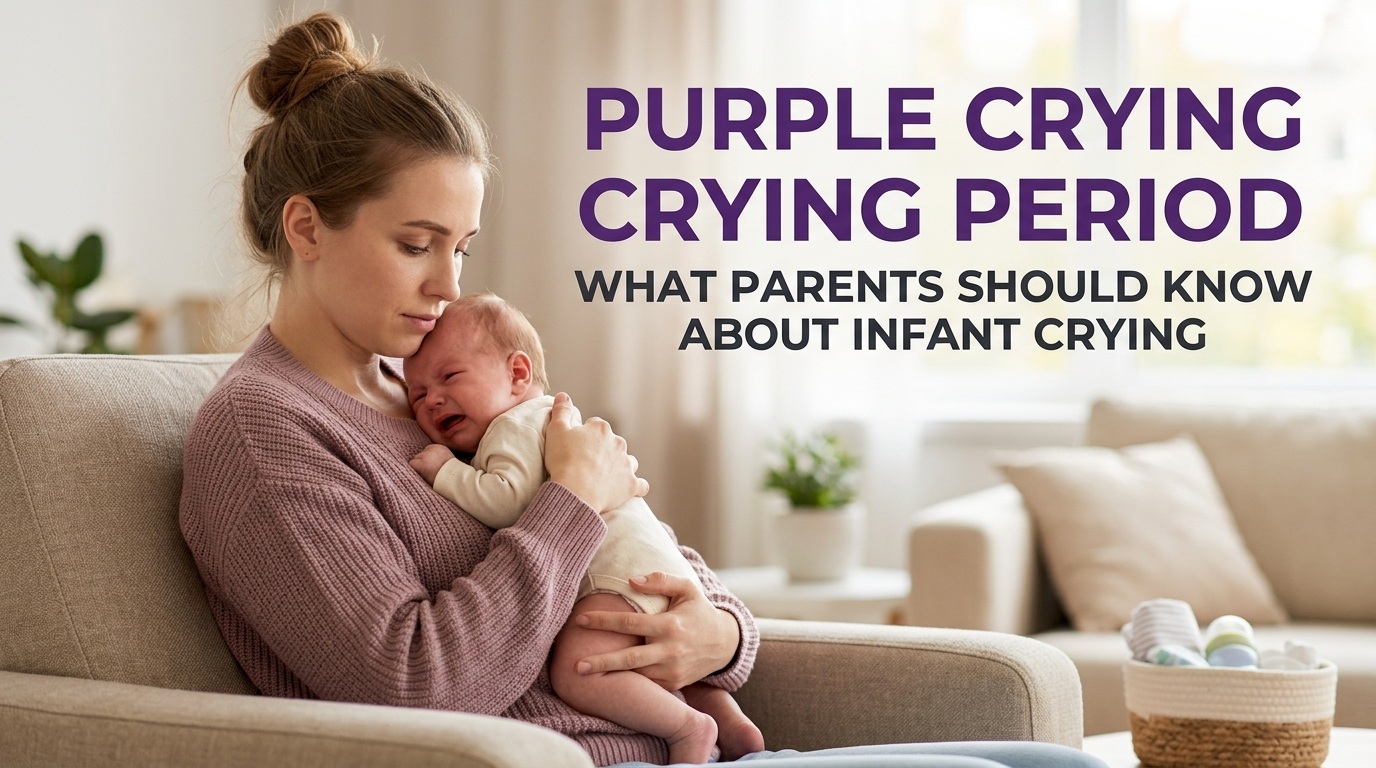
A healthy young baby may cry more frequently, sometimes for extended periods of time, and in spite of attempts to calm them. This phenomenon is known in education as “purple crying.” It usually starts to show symptoms in the few weeks then gets worse in the second month and after that slowly gets better over the next few months. JAMA Network
What is the Purple Crying Period?
The National Center, for Shaken Baby Syndrome created The Period of Purple Crying, a research-based parent education program. Its goal is to help parents understand patterns of increasing crying in early infancy and more importantly stop the risk of abusive head injuries that happen when a baby is shaken. PURPLE Crying
PURPLE is not describing the color of your baby’s face. It is an acronym that summarizes several characteristics of crying that parents may notice during this stage.
The concept is useful since a baby can look to be in distress even when they are generally healthy. However, PURPLE weeping is not an excuse to dismiss new or unexpected symptoms. A sick infant can also cry, thus feeding, temperature, respiration, responsiveness, and behavior changes are all important.
What Does PURPLE Stand For?
The letters help parents remember what this period can look like.
| Letter | Meaning | What Parents May Notice |
| P | Peak of crying | Crying increases during the early weeks and is often greatest during the second month |
| U | Unexpected | Crying may start and stop without an obvious reason |
| R | Resists soothing | Your usual calming methods may not stop the crying |
| P | Pain-like face | Your baby may look as though they are in pain even when no illness or injury is found |
| L | Long-lasting | A crying episode may last much longer than you expect |
| E | Evening | Crying is often more noticeable in the late afternoon or evening |
This pattern is described by pediatric sources including JAMA Pediatrics and Seattle Children’s. JAMA Network
The word period is also important. This stage has an end.
What Is the Purple Crying Period, and When Does It Begin?
Crying becomes most obvious between 2 and 3 weeks of age. Crying tends to increase in the following weeks, peaking during the second month, and then gradually decreasing.
That does not imply that all babies follow the same calendar. Some newborns scream infrequently, while others experience lengthy and difficult-to-soothe episodes. Parents may become particularly concerned around 5, 6, or 8 weeks when a previously peaceful newborn appears considerably fussier.
That timing corresponds to the expected crying curve, but age alone cannot demonstrate that crying is harmless.
If something about your baby’s behavior bothers you, it is appropriate to inform your pediatrician, regardless of the timing to fit PURPLE crying.
How Long Does the PURPLE Crying Phase Last?
For many babies, crying starts becoming less intense after the peak in the second month. The PURPLE program describes crying as decreasing during roughly months 3 through 5, while other pediatric sources describe this type of excessive crying as generally improving by about 3 to 4 months. Seattle Children’s
Consider this as a curve rather than a deadline.
At 12 weeks your baby will not always stop crying and wake up. You might find that the tough evenings get a little shorter your baby cries less. The things you do to calm your baby down start to work better.
If your baby cries for long or it gets worse over time or if your baby has trouble eating or is not growing well or has tummy problems or is acting strange you should take your baby to see a doctor. The Canadian Pediatric Society says you should take your baby to the doctor if your baby is not eating normally or not growing like they should or if your baby is throwing up or has diarrhea or if your baby gets hurt or if your baby cries all the time for months. Caring for Kids
Is my baby’s crying normal or PURPLE?
This is the question I would like parents to consider carefully.
PURPLE weeping refers to a baby who is overall healthy but has episodes of very intense or difficult-to-soothe wailing. You should still look for normal reasons to cry before assuming you’re witnessing this pattern.
Begin by asking:
1. Is my baby hungry or needs to eat?
2. Is the wet or dirty?
3. Is my baby feeling too hot or too cold?
4. Does my baby need to be burped?
5. Is something like clothes or a diaper making my baby feel uncomfortable?
6. Is my baby feeling tired or being overwhelmed by much going on?
7. Is it harder than usual to feed my baby?
8. Is this cry different, from the cry my baby makes?
9. Is my baby showing any signs that something is wrong?
Babies cry to show what they need. The American Academy of Pediatrics says that babies might cry because they are hungry or not comfortable. Sometimes they cry without a clear reason. HealthyChildren.org
Signs That Fit the PURPLE Pattern
A PURPLE crying episode may be more likely when your baby:
· Is in the first few months of life.
· Is feeding and growing normally.
· Appears well between crying episodes.
· Cries more in the late afternoon or evening.
· Can cry for a surprisingly long time.
· Does not always respond to soothing.
· There are no new indicators of disease or injury.
These clues can help you identify a pattern, but they are not a home diagnostic test.
PURPLE Crying and Colic: Are They the Same?
PURPLE weeping and colic are similar, although the phrases are used differently.
Colic has traditionally been defined as excessive sobbing in an otherwise healthy young newborn. The NHS defines it as sobbing for more than three hours per day, three days a week, with no evident cause, usually commencing during the first few weeks and improving after three to four months. nhs.uk
Parents do not need to decide which label fits perfectly before asking for medical advice. It teaches families loud and sometimes hard-to-soothe crying is a normal part of being a baby and shows how parents can handle it in a safe way. The National Center, on Shaken Baby Syndrome created the program specifically to help people understand crying and stop head injuries. Parents might ask for help without knowing the right name for what is happening. PURPLE Crying
What Can You Do When Your Baby Can’t Stop Crying?
One of the parts of PURPLE crying is that it is not always easy to calm the baby down.
That does not mean you should stop trying to help your baby. It means that the focus can change from “get the crying to stop fast” to “keep my baby safe and give them support while this moment passes.”
1. Check Basic Needs First
If your baby is hungry feed them change their wet diaper check their clothes and how they feel and burp them if needed. Talk to your pediatrician, family physician, health visitor, or feeding specialist if sobbing appears to be directly related to each feeding. According to the NHS, crying during feedings can occasionally be linked to reflux or feeding issues. nhs.uk
2. Hold and Rock Your Baby Gently
Try walking slowly moving back and forth gently moving side to side or hugging your baby tightly. According to the Canadian Pediatric Society some babies may find movement helpful, as a way to calm down. Caring for Kids . The key word is gentle. Never bounce or shake violently.
3. Try Sucking
Some babies can be calmed by feeding or non-nutritive sucking with a suitable pacifier. This phase can feel unexpected because what works one evening might not work the next. Caring for Kids
4. Use a Calm Environment
Gentle sound, walking, cuddling, or a warm bath can sometimes help. The NHS and Canadian Paediatric Society both include these types of simple comforting strategies in their guidance for crying babies. nhs.uk
You do not need to cycle through twenty techniques every time your baby cries. If your baby is safe and their basic needs have been checked, calm presence can be enough even when the crying continues.
What If Nothing Works?
One of the most crucial queries parents have is this one: What should I do if PURPLE weeping can’t be calmed?
You don’t have to push yourself until you feel unhappy. That unhappy feeling grows into anger but you can keep giving small comfort.
If you start to feel much put your baby in their crib or another good safe place to sleep and take a little time to calm down. When it’s feasible, ask a spouse, family member, or reliable caregiver to step in. Both the NHS and Canadian Pediatric Society specifically recommend taking a short break when crying becomes overwhelming. nhs.uk
This short safety break is not the same thing as ignoring your baby’s needs. It is a strategy for keeping both you and your baby safe during an extremely stressful moment.
Never Shake a Crying Baby
You should never shake a baby. This is very important. A newborn baby should never be struck or thrown or suffocated.
The PURPLE screaming program was made by the National Center on Shaken Baby Syndrome. They did this because when newborn babies scream for a time it can be very frustrating for the people taking care of them. If you shake a baby violently it can be fatal. Cause serious brain damage. PURPLE Crying
Make sure everyone who takes care of your baby knows about this. This includes your partner and grandparents and relatives and babysitters and other caretakers.
Remember Safe Sleep After Your Baby Settles
There is a difference between sleeping and calming your baby.
When your baby is ready to sleep the American Academy of Pediatrics says you should use a flat mattress with a fitted sheet. You should put your baby on their back in their sleeping area. Do not put things like pillows or loose blankets or stuffed animals or bumpers in the sleeping area.
If your baby falls asleep in a car seat or swing or stroller you should move them to a flat sleeping surface as soon as you can.
[INTERNAL LINK NEEDED: safe sleep guidelines for babies]
Does PURPLE Crying Mean My Baby’s Sleep Schedule Is Wrong?
No it does not mean that.
Newborn babies do not sleep for periods of time. The American Academy of Pediatrics says that newborn babies usually sleep for one or two hours at a time before they wake up. They do not have sleep cycles like older babies do.
So having a sleep schedule will not stop your baby from crying every night. Many things affect how your baby sleeps, like their sleep patterns and development and temperament and feeding needs.
If you are looking for information, about sleep regression ages or when babies sleep through the night just remember that it is normal for babies to wake up at night when they are young. As babies get older some of them start sleeping for periods of time but all babies are different. nhs.uk
[INTERNAL LINK NEEDED: baby sleep schedule by age]
[INTERNAL LINK NEEDED: sleep regression ages]
[INTERNAL LINK NEEDED: when do babies sleep through the night]
Could It Be Teething Instead?
Usually, PURPLE crying begins earlier than typical teething.
Teething typically starts about six months; however timing varies, according to the American Academy of Pediatrics. More significantly, a genuine fever of 100.4°F (38°C) or above cannot be explained by teething. HealthyChildren.org
A very young baby’s fever should not be mistaken for teething or purple screaming.
[INTERNAL LINK NEEDED: teething symptoms in babies]
When Crying Is a Medical Warning Sign
Just because a baby is crying a lot doesn’t mean it’s PURPLE crying.
Get in touch with a doctor right away if:
· Your baby’s cry suddenly sounds different.
· Your infant is not eating well or is refusing to eat.
· Your infant is experiencing diarrhea or vomiting.
· Your infant is not putting on the weight that was anticipated.
· The crying pattern has changed significantly.
· You suspect pain, illness, or injury.
· You are worried even if you cannot explain why.
Pediatric guidance consistently encourages parents to seek medical assessment when crying is unusual or accompanied by other health concerns. nhs.uk
Fever in a Baby Under 3 Months
An infant who is three months or younger and whose rectal temperature is 100.4°F (38°C) or above has to be evaluated right away. In this age bracket, the American Academy of Pediatrics recommends getting in touch with the pediatrician right away. HealthyChildren.org
Seek Emergency Help for Serious Symptoms
If your baby has a lot of trouble breathing turns blue or gray or is really pale you need to get help away. This also applies if your infant is floppy or hard to wake up has a seizure or throws up a lot. The baby might have an illness so it is very important to get emergency medical help.
When your baby cries in a way that’s not normal or shows severe symptoms you should get them checked out immediately. The National Health Service says you should do this to make sure your baby is okay. nhs.uk
“PURPLE crying” does not refer to a baby’s lips, tongue, or skin being blue or purple. Consider color change as a possible emergency, particularly if it is accompanied by breathing difficulties or decreased attentiveness. nhs.uk
Should You Change Formula or Try Colic Remedies?
Don’t give herbal, “natural,” or over-the-counter colic medications or make frequent feeding adjustments without first talking to your baby’s doctor.
According to the Canadian Pediatric Society, most newborns’ screaming will likely not be alleviated by alternating between breastfeeding and formula or by changing formula frequently. Additionally, because there is little evidence to support several over-the-counter or natural colic therapies, it suggests consulting a physician before taking any of these products. Caring for Kids
If your infant is having trouble eating or they are not growing well or they have blood in their stool or they keep throwing up or they have any sign that worries you then that is a different story. Your infant needs to see a doctor for an examination that is just for them instead of trying to figure out what to do at home when they have certain symptoms, like these. Caring for Kids
Frequently Asked Questions
Do all babies experience PURPLE crying?
Babies cry spontaneously, but the strength and duration of the PURPLE pattern differ significantly. Some infants cry for extended periods of time, making it difficult to soothe them, but others are far less fussy. Do not compare your baby’s crying hours to those of another family; instead, consider your baby’s overall health and typical behavior.
Is PURPLE crying harder at night?
It is frequently more evident in the late afternoon or evening, which is why E stands for Evening in the PURPLE acronym. However, tears can also happen at other times. An abrupt change in your baby’s regular crying pattern, regardless of time of day, requires immediate attention.
How can I know if my kid is not in pain?
The cause of sobbing cannot be accurately determined based just on facial expression. The PURPLE framework clearly acknowledges that healthy crying babies may display a pain-like expression. If the sobbing is new, unusual, coupled with fever, poor eating, injury, vomiting, difficulty breathing, or your instincts tell you something is wrong, get medical attention.
Should I pick my baby up whenever they cry?
Young babies require responsive care; consoling them does not “spoil” them. According to the Canadian Pediatric Society, parents cannot spoil their newborn by responding kindly to weeping, caressing, or rocking them. However, if you become overwhelmed, place the baby safely in their cot and take a short break.
Can PURPLE crying suddenly stop?
Improvement is typically gradual rather than occurring on a single day. As your baby progresses thru months 3, 4, and 5, you may see less crying episodes and more successful soothing. If sobbing grows more intense, starts later than expected, or is accompanied by other symptoms, consult your pediatrician.
What I Want Parents to Remember
As a pediatrician, I can leave you with the most important message: PURPLE weeping is a period, not a parenting test. You can feed, hold, rock, comfort, and care for your baby correctly while still weeping.
Check your baby’s needs, provide gentle comfort, and be aware of any changes that may signal illness. If frustration gets unbearable, put your baby down safely and seek help. And if anything about your baby’s weeping raises medical concerns, contact your baby’s doctor rather than assuming it’s just a phase.
Knowing that PURPLE weeping can occur does not mean you should ignore your intuition. It entails understanding typical newborn growth but also recognizing when your baby requires additional assistance.