
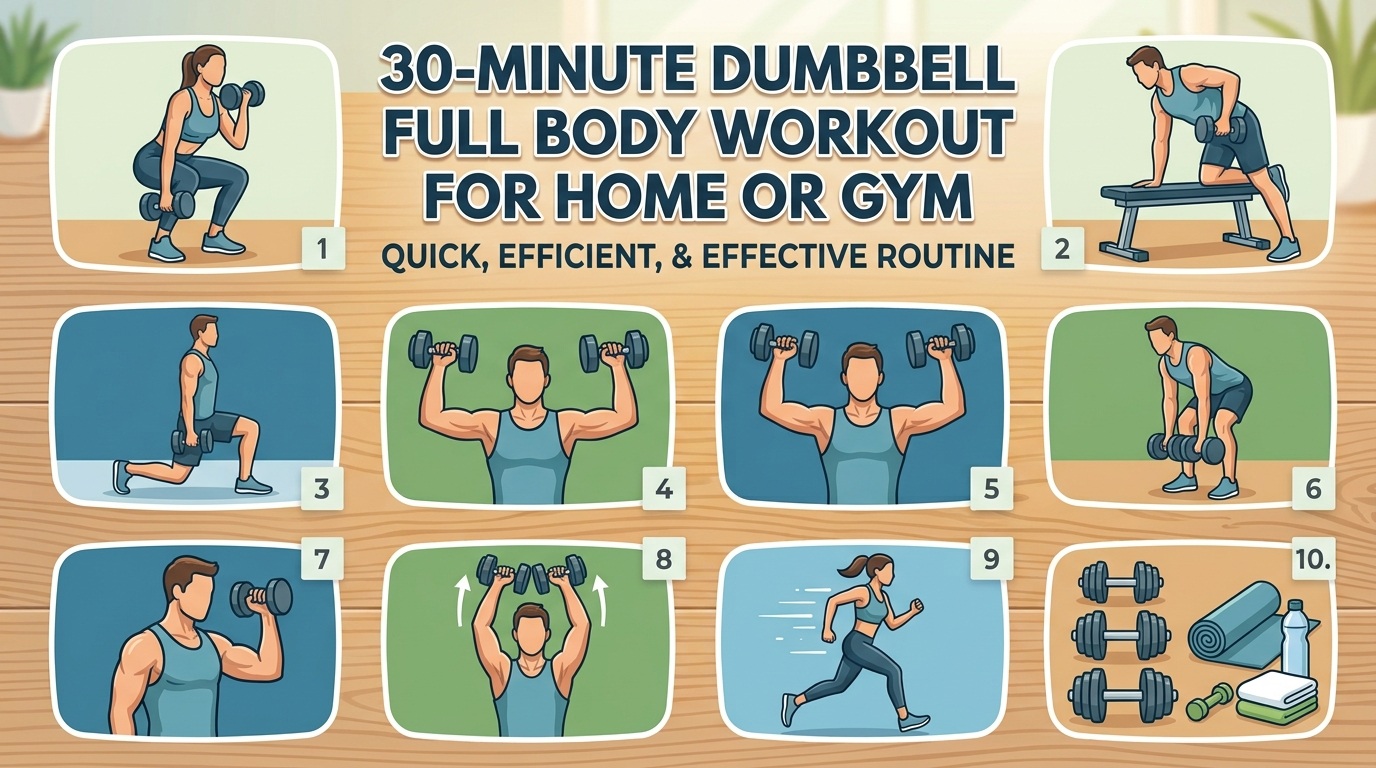

John is a fitness enthusiast who believes strength training does not need to be complicated or take over your schedule. He submitted this workout to LivingSwag to share a simple approach for people who want to train their whole body with basic equipment and limited time.
If you have ever skipped a workout because you only had 30 minutes, I want to show you why that time can still be useful. I’m John, and over time I’ve become a big believer in keeping strength training practical: choose a few effective movements, train your major muscle groups, and focus on good form instead of filling a session with unnecessary exercises. That is the idea behind this dumbbell full body workout. With just a pair of dumbbells, you can train your legs, chest, back, shoulders, and arms at home or in the gym. I’ll walk you through the workout, explain how to choose an appropriate weight, and show you how to make it more challenging as you become stronger. For muscle and strength gains, consistency, appropriate effort, recovery, and progressive training matter more than simply making workouts longer. acsm.org
Can a 30-Minute Full Body Workout Really Be Effective?
Yes. There is no rule that says a strength workout has to be 45, 60, or 90 minutes in duration.
Current American College of Sports Medicine reports that doing regular resistance training is a simple nature as opposed to very complex programs. In 2026 they put forth that you should work all major muscle groups at least twice a week and also that you can improve strength, muscle size, and physical function with home based resistance training. acsm.org
Research looking at full body versus split routines reports no difference in terms of strength gain or muscle growth when total weekly volume is equal. In other words a full body program may work well for you if it fits into your schedule and gives your muscles sufficient work over the week. (PubMed)
In 30 minutes’ productivity can be achieved but may not in all cases it is a fitness achievement. So, especially if aerobic activity is required; we are told that based on present public health report notes that adults do well health wise. They should do muscle strengthening activities at least twice a week in addition to appropriate aerobic activity. (CDC)
What You Need for This Dumbbell Full Body Workout
You don’t require much equipment:
· A set of dumbbells, or if you prefer it weighted to your choice
· A large open space in which you can move safely
· An exercise pad if the floor is uncomfortable
· A timer
· Water nearby
If you have a set of dumbbells you may notice that your legs do better with heavier weight than your shoulders or arms do. It is fine to change weights between exercises.
If you have a single set then the workout still works. What may change is repetition count, movement speed, or the difficulty of the exercise when the weight is too light or too heavy.
How Heavy Should Your Dumbbells Be?
Choose a weight that you can control through the entire whole movement. At the end of the set you should still be challenged by it, but do not have to twist, bounce, and short change the movement greatly, or lose your balance to get out of it.
Mayo Clinic says to start with a weight that is manageable for you which is performed properly and to increase the resistance as you get stronger. If at any point your form breaks down — reduce the weight or the number of reps. (Mayo Clinic)
For this routine we have to do about 8 – 12 controlled reps during each 40 second work interval. Also if at any point your form breaks down you may stop the exercise.
Beginners should prioritize movement quality before worrying about heavier dumbbells.
[INTERNAL LINK NEEDED: beginner gym workout plan]
Warm Up Before the Workout: 6 Minutes
From the desk or the drive home to the gym to jumping into loaded squats and presses is a not ideal. A short warm up session allows you to go over the movements and slowly build up activity which in turn adds to the resistance.
The NHS says to properly warm up before exercise which should last at least 6 minutes. nhs.uk
· Spend 1 min on each movement
· March in place: Gradually pick up the pace
· Arm swings and reaches: Move the shoulders within a comfortable range.
· Bodyweight good morning: As you go through the motion bring your hips back and keep your back in check.
· Bodyweight squats: Master the form first before adding weight.
· Alternating reverse lunge: Go as shallow as you need to.
· Wall and counter top pushups: Finish by warming the upper body.
· You should feel better informed and energized.
[INTERNAL LINK NEEDED: how to warm up before workout]
The 21-Minute Dumbbell Full Body Workout
Set a timer for 40 seconds of work followed by 20 seconds to rest or change position.
Complete all six exercises to finish one round. One round takes six minutes. Perform three rounds, with an additional 90 seconds of recovery after Round 1 and Round 2.
That gives you 21 minutes of training.
| Exercise | Main Areas Trained | Work |
| Goblet squat | Quads, glutes | 40 sec |
| Dumbbell Romanian deadlift | Hamstrings, glutes, back | 40 sec |
| Dumbbell floor press | Chest, shoulders, triceps | 40 sec |
| Bent-over dumbbell row | Back, arms | 40 sec |
| Reverse lunge | Legs, glutes | 40 sec |
| Dumbbell shoulder press | Shoulders, triceps | 40 sec |
1. Goblet Squat
Hold one dumbbell close to your chest with both hand. Stand in a comfortable position, bracing your core and at the same time at hip and knee flexion lower yourself slowly.
Keep your feet still and spine straight. As you rise push with your feet and don’t allow the weight to pull you forward.
For squat form, depth should match your present mobility and control not a set target. Mayo Clinic reports that the spine should stay stable and the knees over the feet during a dumbbell squat. Mayo Clinic
Beginner option: Perform the movement without a dumbbell or squat toward a stable chair.
[INTERNAL LINK NEEDED: squat form guide]
2. Dumbbell Romanian Deadlift
Hold the dumbbells in front of your thighs. Keep a soft bend in your knees and push your hips backward while the weights travel down the front of your legs.
Stop when you feel tension through your hamstrings and can still maintain a controlled spine. Drive your hips forward to stand again.
Think about moving your hips backward rather than trying to lower the dumbbells all the way to the floor.
Beginner option: Reduce the range of motion and practice the hip hinge with light dumbbells.
3. Dumbbell Floor Press
Lie on your back with your knees bent and feet on the floor. Hold a dumbbell in each hand with your upper arms resting lightly against the floor.
Press the weights upward until your arms are extended without forcefully locking your elbows. Lower them slowly until your upper arms contact the floor again.
The floor limits how far your elbows can travel behind your body, making this a practical pressing exercise when you do not have a bench.
Beginner option: Use one dumbbell held securely in both hands or choose lighter weights.
4. Bent-Over Dumbbell Row
Hold a dumbbell in each hand and push your hips backward until your torso leans forward comfortably. Keep your trunk stable.
Pull the dumbbells toward your sides while bringing your shoulder blades back, then lower the weights with control.
Avoid jerking your torso upward to move a weight that is too heavy. Proper form should remain the priority throughout weight training. Mayo Clinic
Beginner option: Perform one arm at a time while supporting your free hand on a sturdy bench or chair.
5. Reverse Lunge
Stand tall with a dumbbell in each hand. Step one foot backward and lower yourself as far as you can comfortably control.
Push through the front foot to return to standing and alternate legs.
Keep the movement slow enough that balance does not become the main challenge.
Beginner option: Do bodyweight reverse lunges or hold a stable surface for support.
6. Dumbbell Shoulder Press
Hold the dumbbells near shoulder height. Brace your trunk and press the weights overhead without excessively arching your lower back.
Lower them gradually to the starting position.
If standing presses are difficult to control, use lighter weights or perform the movement seated on a stable chair with appropriate back support.
Beginner option: Press one dumbbell at a time.
Finish With a 3-Minute Cooldown
After the last round take it easy for about three minutes. Walk around the room at a slow pace till your breathing returns to normal, then gently go through full comfortable ranges of motion for your shoulders, hips, and legs. A cool down is not a time for a work out.
If you have sudden dizziness, chest pain, or shortness of out of proportion to what you would normally expect during your exercise routine, stop. The NHS has put forth that symptoms of chest pain, dizziness, and severe shortness of breath are reasons to stop exercise and seek out proper medical attention. Torbay NHS Trust
Is a 30-Minute Full Body Workout Enough to Build Muscle?
Yes, a 30 minute workout can put on muscle mass so long as the weekly routine is very challenging.
Muscle growth is not limited to the duration of the session. Instead what you do in the week, the resistance you use, how hard you go, your recovery, what you put in your body, and your consistency all play a role.
ACSM has put out in 2026 that which is in regard to people that are trying to do what they can for muscle growth hypertrophy they may look at around 10 sets per muscle group per week. Also it is put forth that programs should still be tailored to the individual. acsm.org
Performing this workout two or three times a week which in turn gives you repeated training of the main muscle groups without the need for daily lift. If muscle growth is what you are after you may at a later stage require to do more sets or to increase the weight as you progress in your training.
Can You Get Results With Just Dumbbells at Home?
Yes. Dumbbells are a great home workout tool for getting in strength and muscle building routine.
ACSM in 2026 reported that which traditional gym equipment is not required for one to see improvement and also reports that home based routines are an effective solution. acsm.org
The issue appears when the dumbbells you have at your disposal are no longer a challenge. This tends to happen first in large muscle groups like the legs.
At that point, you can:
· Increase the dumbbell weight.
· Add repetitions within a useful range.
· Add another set.
· Use a harder variation.
· Increase the controlled range of motion when appropriate.
· Slow the lowering portion of the exercise.
These are ways of applying progressive overload, which simply means making training gradually more demanding as your body adapts.
[INTERNAL LINK NEEDED: progressive overload guide]
How to Use Progressive Overload Without Rushing
Progress doesn’t mean adding weight to the bar every session. Suppose if you begin doing goblet squats with a 20 pound dumbbell you may do 8 good reps. Over several sessions you may get up to 10 and in time 12 reps with the same weight.
Once you are able to perform 12 controlled reps in your sets you may try a slightly heavier dumbbell and go back to the lower rep range.
Mayo Clinic also reports to increase resistance as strength improves at the same time that technique stays correct. (Mayo Clinic)
Track at least three things:
Weight used
Repetitions completed
How controlled the final repetitions felt
That gives you more useful information than judging a workout by sweat or soreness alone.
How Often Should You Do This Workout?
For most healthy adults a practical schedule for beginning a resistance training program is to do it 2 or 3 times a week which do not have to be consecutive days.
Both WHO and U.S. also put forth that it is the charge of each individual to engage in muscle strengthening activities which should include all the major muscle groups at a minimum of twice a week. World Health Organization)
A simple week could look like this:
| Day | Activity |
| Monday | 30-minute dumbbell workout |
| Tuesday | Walking or other activity |
| Wednesday | Rest or light activity |
| Thursday | 30-minute dumbbell workout |
| Friday | Walking or other activity |
| Saturday | Optional third strength session |
| Sunday | Rest or comfortable activity |
You do not need to copy this exact schedule. Recovery needs vary, so adjust it around your training experience and other activities.
How Many Calories Does a 30-Minute Dumbbell Workout Burn?
There isn’t a set calorie count for 30 minute dumbbell workouts. What type of body you have, which exercises you do, dumbbell weight, time taken for breaks between sets, your fitness background all that plays a role.
In 2024 The 2024 Adult Compendium of Physical Activities reports that which is to resistance training using many exercises at various resistances are 3.5 METs and that for vigorous weight lifting it is 6 METs. A MET is a standard what researchers use to report on the energy cost of different activities. (Compendium of Physical Activities)
Using those values only as rough estimates, 30 minutes might look like this:
| Body Weight | Approx. 3.5 MET Session | Approx. 6 MET Session |
| 132 lb / 60 kg | 105 calories | 180 calories |
| 165 lb / 75 kg | 131 calories | 225 calories |
| 198 lb / 90 kg | 158 calories | 270 calories |
These are estimates, no promises. The benefit of the workout is not to be determined solely by what a watch or calculator reports on calories you burned.
Common Mistakes That Make a Short Workout Less Effective
Going Too Heavy Too Soon
A weight which forces you to shorten reps or use momentum is not always for better results. Try reducing the load and building control first. (Mayo Clinic)
Turning Every Exercise Into Cardio
Short breaks do save time, but rushing does cause strength exercises to be done poorly. Pay attention to your body’s needs for extra recovery in particular while you are still learning the movements.
Never Increasing the Challenge
If for long term use the same easy resistance, your body will adapt and progress slows. Gradually increase weight, reps, sets or the difficulty of the exercise.
Changing the Workout Every Session
Constant change in exercise may make it hard to see progress. Research reports that structured variety is valuable but too much random change may in fact reduce strength or muscle gain. (PubMed)
Treating Soreness as the Goal
A workout doesn’t have to leave you in a lot of pain to be effective. Instead of going for the most painful routine put focus on what you gain in terms of strength and consistency.
Who Should Get Medical Guidance Before Starting?
This workout is written for generally healthy adults, not as rehabilitation or treatment for a medical condition.
If you are pregnant, recovering from surgery or injury, have significant cardiovascular or musculoskeletal disease, have been told to restrict exercise, or have another condition that changes what exercise is appropriate for you, seek individualized guidance from a qualified healthcare or exercise professional.
Stop exercising and seek appropriate care for concerning symptoms such as chest pain, severe or unusual shortness of breath, faintness, or significant dizziness. (Torbay NHS Trust)
Frequently Asked Questions
Is it true that a 30 minute dumbbell workout is good for beginners?
Yes, if the exercises and weights are at your present level. For beginners start with lower resistance, use what is comfortable for range of motion and spend time with each exercise to perfect form before increasing speed. If an exercise causes pain or you do not have control of the movement, stop and modify it out of necessity rather than to complete the reps as prescribed.
Can I do a dumbbell full body workout every day?
You do not have to train the same muscles daily to see results. Present health guidelines report that it is enough to do muscle strengthening activities at least 2 days a week and also that allowing for recovery in between more intense sessions will help you maintain your training quality. (CDC)
What if I don’t have heavy dumbbells?
Use light weights for now which still is a challenge for good controlled training. You can initially add repetitions, slow the lowering phase, or choose harder exercise variations. If possible use heavier dumbbells once a movement becomes very easy even with those changes.
Should I add in some cardio to this?
For health in general that’s true. Strength training and aerobic exercise play similar yet separate roles. The US’ current guideline is to get at least 150 minutes of moderate intensity aerobic activity weekly or the equivalent in more intense activity also which to do at least 2 days of muscle strengthening exercises. (CDC)
How soon will I see results from dumbbell training?
There is in fact no set time frame which works for everyone. Your base fitness, training consistency, and resistance you are putting to it, nutrition, sleep, age, and goal you are working out also play a role. Instead of putting stock in a certain look at the numbers at a certain week, work on doing more controlled reps, using heavier weight, or finishing the same routine with better form.
Make the 30 Minutes Count
A simple full body dumbbell workout doesn’t require a bunch of different exercises. Squat, hinge, push, pull, consist in your training, and as you improve increase the challenge.
Start off with 2 times per week 30 minute sessions and track the weights and reps you use. After a few weeks use that info to determine if you need more resistance instead of lengthening the workout.