
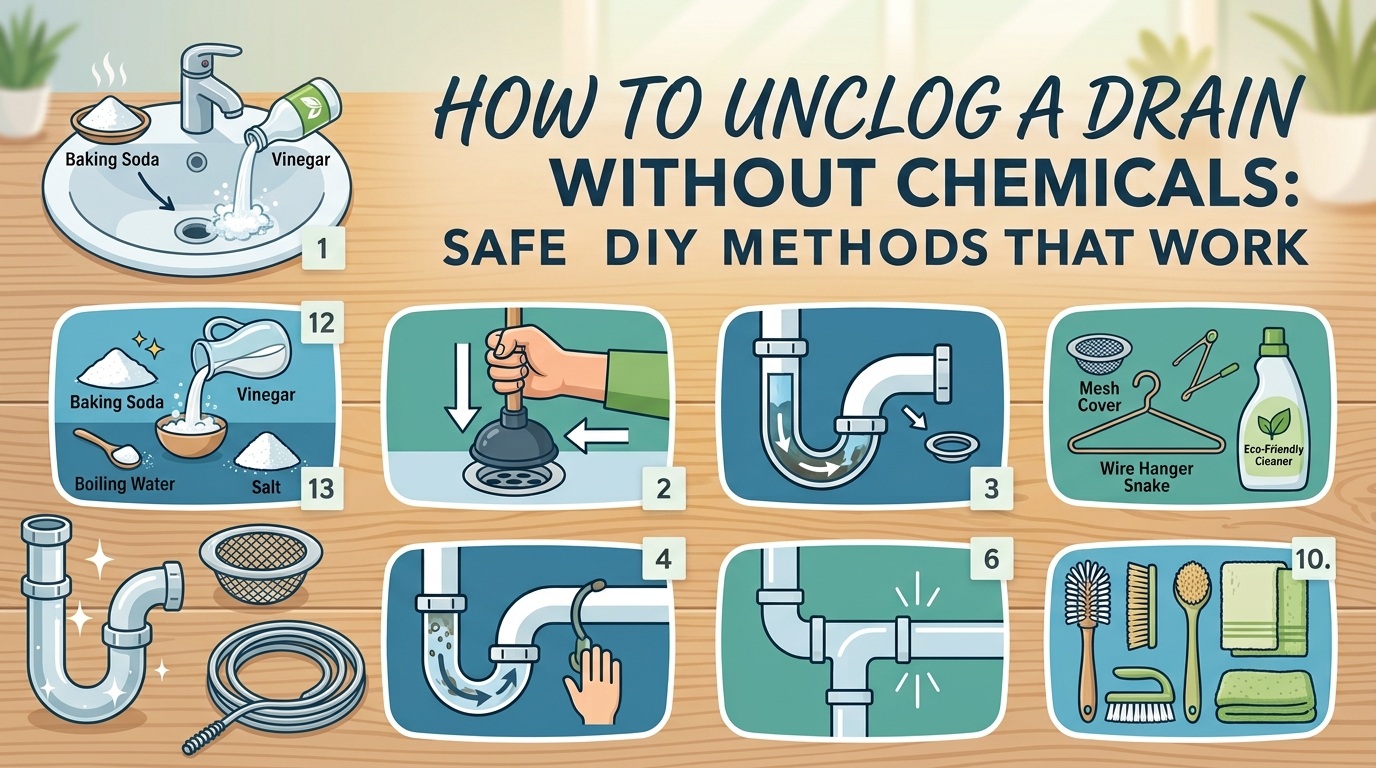

Maya, a renter with a busy weekday routine, first noticed something was wrong when the bathroom sink stopped emptying as quickly as usual. By the next morning, water was pooling around the drain while she brushed her teeth, and her first thought was to reach for a strong drain cleaner. Instead, she wondered whether there was a safer way to fix the problem without pouring harsh chemicals into the pipes. That question is where many homeowners and renters find themselves. If you are trying to learn how to unclog a drain without chemicals, the best place to start is usually with the blockage itself. Hair, soap buildup, food debris, and small obstructions can often be removed with simple tools such as a plunger, drain snake, or careful trap cleaning.
Before You Unclog Anything, Figure Out What Is Blocking the Drain
The fastest method will depend on your clog’s location and probable cause.
Pouring random substances into your drain without figuring out what you’re dealing with just wastes time and could lead to a messier repair later on.
Bathroom Sink
Hair, soap, toothpaste, and other debris can build up under bathroom sink drains. Start at the top of the pipe since it’s possible you’ll find your clog near the surface. You will be able to clear it out by hand (or a basic drain tool).
Shower or Bathtub
Start with your hair! This is one of the most common things you can find clogging up your slow-moving shower or bathtub drains. In many cases using a plastic hair-removal tool is easier and quicker than experimenting with various liquid solutions.
Kitchen Sink
A kitchen clog could be caused by food debris, grease, or other kinds of buildup in your kitchen’s trap or drain lines. It’s important to note that according to the Environmental Protection Agency (EPA), you shouldn’t pour cooking oil or grease down your sinks, especially if your home has a septic system. (US EPA)
It might help to first check if there’s an issue with the drain or if there are problems with your garbage disposal if your kitchen sink features one.
Several Drains at Once
A single sluggish sink could just indicate there’s an issue with that specific drain.
But if multiple fixtures are backed up or have poor drainage at the same time, this suggests a larger drainage issue. This is definitely not the ideal scenario for DIY experimentation. If multiple drains are affected or if you see sewage coming up or water going somewhere other than where it should when using another fixture, call in a qualified plumber or your property manager.
Safety First: What Not to Do With a Blocked Drain
But while these steps sound straightforward, there are some dangers associated with exposing yourself or your family members to chemicals and then coming into contact with the wastewater itself. Health Canada notes that “household chemical products, such as drain cleaners, can lead to poisoning, burns, fires or even explosions if mishandled.” They specifically warn against mixing bleach with other kinds of cleaning products since doing so creates “dangerous gases.” (Canada)
Follow these rules before starting:
- Wear household or waterproof gloves when handling drain debris.
- Keep children and pets away from the work area.
- Do not randomly combine bleach, drain opener, vinegar, ammonia, disinfectants, or other cleaners.
- Do not dismantle plumbing if you know a strong drain cleaner is still sitting inside it.
- If you rent, avoid modifications your lease or landlord does not permit.
Already Used Drano or Another Chemical Drain Opener?
Don’t go straight for plunging the clog away at this point either.
Drano’s current instructions advise against plunging when using their own drain openers because “chemical product may be left in the drain which failed to clear and may splash back” on the user. (Drano)
If you’ve poured one down an entirely blocked drain, be sure to read and follow all of the instructions listed on the container. You don’t want to risk injury by misusing anything, and if things still won’t unclog themselves after trying everything else. Give your plumber details about the chemical products you tried ahead of time so they know to wear protective equipment.
How to Unclog a Drain Without Chemicals: Start With the Least Invasive Fix
Do you need all of these methods? No. Start from the simplest one and stop when your sink drains normally.
Step 1: Remove the Stopper and Visible Debris
Pull up the drain stopper or strainer if there’s one attached. There might be hair and sludge building up under that point.
Put on gloves and get rid of whatever you’re able to grasp with no risk involved. You could try using a plastic drain cleaning strip to do a little bit more deep cleaning. If this is an issue that happens in a bathroom sink specifically, be sure to wipe down the area around the stopper as well as where water drains out. Try plugging the drain and seeing whether or not it works now.
Now run a little bit of water.
If your drain starts to flow again without problems, then you might just have been done!
Step 2: Use a Plunger Correctly
Pushing down on the plug of liquid sitting at the bottom, the plunger moves water back and forth through the drain, which can also help to clear out any blockages.
For a sink:
1. Remove some of the water so there won’t be overflow when using the plunger.
2. Add more water until it covers the bottom edge of the plunger’s cup.
3. Position the plunger on top of the drain and press it down firmly.
4. Cover the sink’s overflow opening with a wet cloth if at all possible.
5. On a double kitchen sink, seal the second drain.
6. Plunge with controlled up-and-down movements several times.
- Remove the plunger and check the water flow.
UK public housing guidance suggests covering overflow openings when using a plunger since it creates more effective pressure against the blockage. Tower Hamlet
Don’t use excessive force. Try switching up your method instead of continuously stressing drain connections if you find that there’s no progress being made with an existing strategy after multiple attempts.
Step 3: Pull the Clog Out With a Drain Snake
If plunging does not work, a small hand-operated drain snake or drain auger is often the next useful tool.
Feed the cable slowly into the drain until you feel resistance. Rotate it gently, advance it slightly, then pull it back. The goal is either to hook the blockage or break through enough material for water to flow again.
You may need to repeat the process several times.
This mechanical approach is also consistent with EPA advice, which recommends a plumber’s snake instead of chemical drain cleaner for household hazardous-waste reduction and specifically advises a drain snake as an alternative to chemical drain openers for septic systems. US EPA
For showers and tubs, a small plastic hair tool may be enough if the clog is near the opening.
Still Clogged? Check the P-Trap Under the Sink
The curved pipe under many sinks is commonly called a P-trap in North America and is sometimes referred to as a U-bend in the UK. Its water seal helps keep sewer gases from entering the room.
Debris can also collect inside it.
If the trap is accessible and you are comfortable removing it:
- Stop using the sink.
- Place a bucket and old towels under the trap.
- Take a photo of the existing pipe arrangement before loosening anything.
- Carefully loosen the slip-joint nuts.
- Lower the trap into the bucket.
- Remove debris and rinse the trap.
- Reinstall it in the same position.
- Run water and check closely for leaks.
Tower Hamlets Council similarly advises placing a bucket under the U-bend, removing accumulated debris, reinstalling it, and checking whether the blockage has cleared. (Tower Hamlets)
Do not remove the trap if chemical drain opener may still be trapped in the pipe. Renters should also check whether plumbing repairs must be handled by their landlord or maintenance team.
Can You Use Baking Soda and Vinegar to Unclog a Drain?
Yes, you can attempt using baking soda and vinegar if your drains are only slightly blocked up – but it’s definitely not your best bet for when they’re really backed-up with things like hair, food, etc.
According to the American Chemical Society, vinegar reacts with the bicarbonate in the baking soda to make carbon dioxide gas, water and sodium acetate. The bubbles you see are carbon dioxide. American Chemical Society For light residue, UK public housing guidance suggests:
- Pour about ½ cup of baking soda into your drain.
- Add about ½ cup of vinegar.
- Allow it to fizz for approximately 15 minutes.
- Flush with hot water. Tower Hamlets
It’s pretty much what you’d expect from a light attempt at cleaning; though remember if you have hair, objects or heavy buildup to remove the physical blockage first.
Never follow up this reaction by adding vinegar) if you’ve used bleach or an unknown drain cleaner. Health Canada warns that bleach reacts with acids like vinegar creating toxic gas Recalls and Safety Alerts
What Do Plumbers Recommend Instead of Drano?
The above recommendation does not represent all plumbers but serves as general guidelines from an official source. For avoiding household drain cleaner, here are some recommendations from the US EPA:
Two simple alternatives for household drain cleaner
• A plunger
• A plumber’s snake US EPA
EPA septic-system guidance recommends against using chemical drain openers, too, but suggests using a drain snake or hot water instead. US EPA
That suggests a useful DIY order:
Remove debris → plunge → snake → inspect the trap → call a professional if necessary.
This sequence attacks the physical cause of the clog instead of repeatedly adding products to standing water.
Best Method for Different Types of Clogs
Not every drain should be treated the same way.
| Problem | Best First Approach |
| Hair near shower drain | Remove stopper and use hair-removal tool |
| Bathroom sink draining slowly | Clean stopper, then plunge |
| Deeper bathroom clog | Hand drain snake |
| Kitchen sink blockage | Plunger, then inspect trap |
| Accessible debris in P-trap | Remove and clean trap |
| Garbage disposal drain clog | Follow disposal instructions; consider plunging |
| Multiple slow drains | Contact a plumber |
| Repeated clog in same fixture | Professional diagnosis |
What If the Kitchen Sink Has a Garbage Disposal?
A clogged disposal drain needs extra care because an electrical appliance is attached to the plumbing.
Never reach your hand into the disposal chamber. InSinkErator’s current support instructions specifically say not to place your hand inside a garbage disposal and recommend using the manufacturer’s wrench or other model-specific procedure for a jam. InSinkErator Support.
If the disposal operates but water will not drain, the manufacturer recommends a plunger as one troubleshooting option. For double sinks, the other drain should be blocked so the plunger can create useful pressure. InSinkErator Support
If your issue is odor rather than a blockage, that is a different maintenance task.
[INTERNAL LINK NEEDED: how to clean garbage disposal]
Why Does My Drain Keep Clogging?
Your drain might be getting constantly clogged due to various factors such as continuous hair or food coming into your drain, grease accumulation, some blockage further down the line, etc. There could also be other plumbing issues which a short-hand snake can’t tackle.
Start with prevention:
Catch Hair and Food Before They Enter
Try using a removable strainer in your kitchen sink or hair-catching covers on shower or bathtub.
Tower Hamlets Council recommends sink strainers for keeping food scraps out of kitchen drains.
Keep Grease Out of the Sink
Allow your cooking fat to cool then dispose of it properly instead of throwing it away down the drain.
The EPA and the UK councils agree on this point too – make sure you keep all cooking grease and oil out of your drain lines. US EPA
Clean Stoppers Before They Become Blockages
They’re able to trap hair and soap for much longer than they would be if the drain were entirely blocked up. By adding them into your normal routine when you clean out your bathroom this could help prevent some sluggish drains from happening over time.
This is an easy item to add to a monthly deep cleaning checklist.
[INTERNAL LINK NEEDED: deep cleaning checklist]
Use a Garbage Disposal as Directed
Remember to use your disposal only per the model you have selected because some manufacturers recommend not pouring fat, oil or grease into their disposals.
You should also always run water while operating these units normally, according to InSinkErator
When Should You Stop DIY Drain Cleaning and Call a Plumber?
If you’re working on a simple clog at the sink, keep going with what’s left of your DIY efforts.
But if you’ve determined there is an issue within your entire plumbing system, then it’s time to call a professional plumber for help.
If you need to call on a qualified plumber, your property manager, or another suitable maintenance service, you might notice one of the signs listed below:
· Multiple drains are sluggish or clogged.
· Wastewater or sewage is backing up.
· A clog returns shortly after being cleared.
· Leaking or damaged pipework has been discovered.
· Water appears from elsewhere when using a single drain.
· The drain snake won’t go through OR it’s getting stuck
· Suspect that there is an object deep into your lines
· You use chemical cleaners and you find out the blockage remains
Tower Hamlets Council suggests reaching out if you’re experiencing issues such as water backing up inside your house or drainage issues continuing. They suggest reaching out for help in these situations. Tower Hamlets
[INTERNAL LINK NEEDED: causes of household drain odors]
Frequently Asked Questions
What is the easiest way to unclog a drain naturally?
The most straightforward solution for you would be to remove your sink’s stopper, then try to manually extract any hair or other debris from the bottom of the basin.
If this doesn’t clear up anything, then grab yourself some kind of plunger. The US EPA recommends using plungers and plumber’s snakes instead of commercial household chemicals such as ‘drain cleaners’. US EPA
Is boiling water enough to unclog a drain?
Hot water will do well at helping push through that small amount of light soap or grease. But it won’t actually physically pull hair from your drain. Nor can you really pour enough hot water into a drain pipe to flush anything solid out. A tool might still be necessary if there’s a physical obstruction. US EPA
Does baking soda alone unclog drains?
Baking soda doesn’t actually have the power to unclog your drains all on its own. It makes sense, right? This stuff is good for a quick clean, yes, but it isn’t going to work miracles. It won’t work especially when you have to remove a serious physical blockage.
How long should I plunge a clogged sink?
Try out multiple plunges with control and check if there’s an improvement of drainage. You don’t have to go on and on. Once you find that all your repeated efforts aren’t getting anywhere, consider either taking up a drain snake or checking the trap for any issues. Don’t resort to brute-force tactics.
Can I use vinegar after drain cleaner?
Never add vinegar if you think there might be a commercial drain cleaner, bleach, or another unknown cleaning product in your drain. It’s possible some of these items could react with each other if they mix together – releasing dangerous gases into your home. Health Canada has actually issued warnings about this exact scenario. Recalls and Safety Alerts.
Why does my sink drain slowly even after I clean the stopper?
The blockage may be farther down the drain, inside the P-trap, or deeper in the pipe. Try controlled plunging followed by a drain snake. If the problem keeps returning, professional inspection may be more useful than repeatedly treating the drain.
Clear the Blockage, Not Just the Symptom
Once you’ve assessed your situation and decided that going the natural route is best, here’s what I suggest trying:
Start by getting rid of the actual clog. If it’s within reach, remove anything from the pipe. Then try using a plunger to shift around the blockage, and if that fails, try using a drain snake to dig out. You might want to clean your P trap if it’s something you can safely access.
Once you’ve tried everything above — but still nothing works — it could mean either you need to try yet more remedies OR your pipes are actually messed up. And need fixing ASAP before other drains get plugged as well! Don’t forget after clearing all obstructions & restoring regular flow need good filters on drains that control stuff like hair, food, grease etc.