
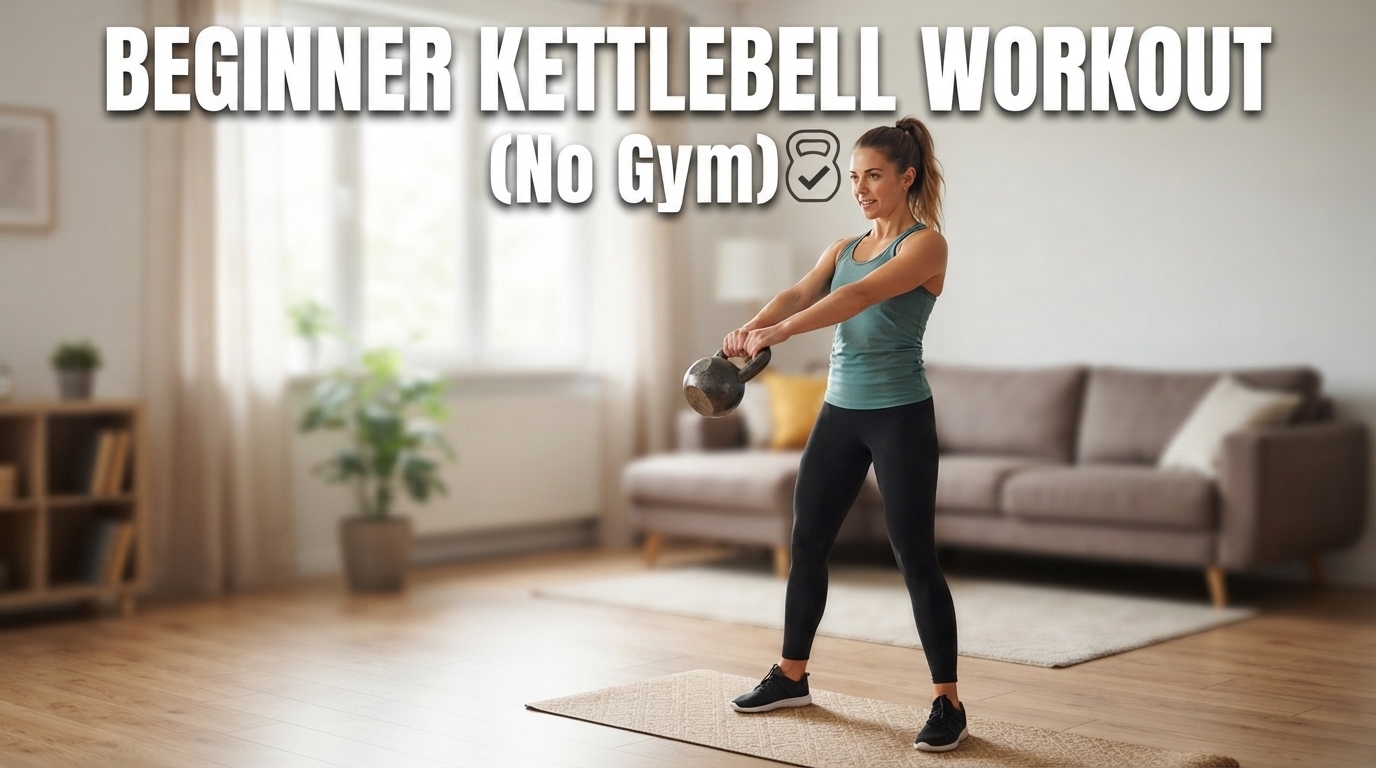

Build Strength at Home
I’m John, and I want to show you that kettlebell training does not need to be difficult. During my 15 years as a gym trainer and fitness coach, I have seen many beginners avoid this useful weight because its shape feels unfamiliar. A kettlebell often enters the home with big plans, and then spends months sitting in a corner. This kettlebell workout for beginners uses five simple exercises, one kettlebell, and a small amount of space. You will learn how to choose a suitable weight, protect your back, and complete a balanced workout without joining a gym.
A beginner kettlebell workout can take 20 to 30 minutes, including the warm-up. Start with two sessions per week on nonconsecutive days. Choose a weight that lets you complete 8 to 10 controlled repetitions without losing your balance or changing your form.
Why a Kettlebell Works Well for Home Training
A kettlebell is a compact weight with a handle. Unlike a dumbbell, most of its weight sits below the handle. This design allows you to hold, lift, carry, and eventually swing it in several ways.
One kettlebell can help you train your legs, back, chest, shoulders, legs, back, chest, arms, grip, and core. You can also perform the exercises in a small room, making this workout useful for busy parents, students, office workers, and anyone who does not want a gym membership.
Kettlebell work can do for you:
• Better overall strength
• Improved balance and coordination
• Stronger muscles for daily activities
• Better grip strength
• Increased physical activity
· Healthy maintenance of weight and also which include proper diet.
Adults do muscle-strengthening activities at least 2 days out of the week as put forth by the CDC’s physical activity guidelines. You don’t have to hit that mark right away. A short controlled session is a good place to start.
What is the best Kettlebell weight for a beginner?
There is no one size fits all for what should be your starting weight as a beginner. Your present strength, age, and what you’ve done in the past in terms of exercise all play a role.
Here is a table to start but don’t follow it strictly:
| Experience level | Possible starting range | Best approach |
| Completely new or returning after a long break | 4–8 kg (9–18 lb) | Learn each movement slowly |
| New but generally active | 8–12 kg (18–26 lb) | Test squats and deadlifts before buying |
| Some previous strength experience | 12–16 kg (26–35 lb) | Use a lighter bell for presses if needed |
Your body may prefer less weight in the shoulders as compared to the hips and legs. For example, what is a comfortable 8 kg kettlebell for a deadlift may be too heavy for a one arm floor press.
Try the 10-Rep Test
Before performing a full workout on the kettlebell do 10 controlled deadlifts or goblet squats.
The weight may be suitable if:
• The first repetitions feel comfortable.
• At times the last 2 to 3 repetitions are tough.
• Your posture is straight and stable.
• You can use the kettlebell without dropping or swinging it.
• You don’t have to hold your breath.
Choose out a lighter weight if you notice your shoulders going up, or your back rounding, or that you’re in a rush to finish. Once you are able to do over 15 reps with ease, you may want to try a heavier weight but first get the movement down.
Prepare Your Space Before You Lift
You have only one kettlebell and a free floor to work with, also leave some space to move your arms around. Also keep kids, pets, furniture and breakable things out of the workout zone.
A hard non slip surface like of an exercise mat is what you want as opposed to thick carpet. As for footwear go for solid soles on your shoes. Soft running shoes may cause you to lose balance because of the thick padding which may shift while you are wearing them.
Place your kettlebell on the floor gently in between exercises. Also do not drop it which is very important when we are at home working out.
Warm Up Before Your Kettlebell Workout
Spend around 5 minutes on your joints and muscles. The warm up should raise your body temperature without leaving you tired.
Perform these movements in order:
• March out for 1 minute. Move your arms naturally and as you go increase the pace.
• Perform 10 shoulder rotations in each direction. Do at a slow pace.
• Perform 10 bodyweight hip hinges. Extend your hips back and at the same time keep your back in a neutral position.
• Perform 8 body weight squats. If you need support use a chair.
• Perform 10 glute bridges. Start in supine position, bend your knees, and lift your hips.
• Hold out the light kettlebell for 20 sec on each side. Stand up straight and keep your body level.
[INTERNAL LINK NEEDED: warm up before workout]
Best Kettlebell Routine for Newbies.
This routine includes 5 basic movements. Also there is no kettlebell swing included as we first get the beginners to learn how to hip hinge and control the weight.
• Perform 8 to 10 reps of each exercise unless otherwise noted.
• Between exercises rest for 30 to 60 seconds
• After you finish all five tasks rest for up to 2 minutes
• Start out with one or two rounds. As you see improvement in your strength and fitness, work up to three.
| Exercise | Amount | Main areas trained |
| Kettlebell deadlift | 8–10 reps | Hips, legs, back and grip |
| Goblet squat to a chair | 8–10 reps | Legs, hips and core |
| Supported one-arm row | 8 reps per side | Back, arms and shoulders |
| One-arm floor press | 8 reps per side | Chest, arms and shoulders |
| Suitcase march | 20–30 seconds per side | Core, grip and balance |
Kettlebell Squat Deadlift
Place your feet hip distance apart and put the kettlebell in between. Sit your hips back, which will cause your knees to go slightly bent. Grasp the handle with both hands.
Plant your feet into the floor and stand tall. Have the kettlebell close to you. Gently tighten your stomach muscles, do not lean back at the top. Hinge at the hips and lower the weight under control.
You will see that this movement is mostly in your hips, thighs, and buttocks. Should you feel lower back pain, reduce the weight of the kettlebell and do the exercise without it.
Goblet squat to a chair
Place a chair at a distance. Take the kettlebell up close to your chest with both hands that are on the handle.
Keep your feet at a width which is greater than that of your hips. Sit your hip bones back and as you slowly lower yourself do so until you almost touch the chair. Push through your feet to stand.
The chair is your frame of reference and also provides extra security. Do not sit on it or use spin to stand.
Supported One Arm Row
Place your hand on the back of a stable chair or edge of a strong bench. Take the kettlebell into the other hand and step back a bit.
Keep a straight spine and pull the weight to the side of your ribs. Hold for a moment, then lower it slowly. Do not twist at the shoulders or bring the weight to your neck.
Complete one set at a time before switching hands.
Single Arm Floor Press
Lie down on your back with your knees bent. Carefully hold the kettlebell in one hand which should be against the outside of your forearm. Keep your wrist straight.
Press the kettlebell to the top of the head until your arm is almost fully extended. Drop your upper arm down to the floor.
The floor plays a role in the range of motion for your elbow which in turn may make this movement easier than a standing overhead press. At times it is best to use both hands to help in the in and out of position action of the kettlebell.
Suitcase March
Holding the kettlebell at your side as if you are carrying a suitcase. Stand up straight without leaning into or away from the weight.
Slowly walk in place for 20 to 30 seconds. Maintain small steps and position your ribs over your hips. Switch hands and do it again.
This exercise will improve your grip and also train your core to maintain stability when you’re carrying weight on one side.
What is the duration for a beginner of work out?
A beginner’s kettlebell session should go for 20 to 30 minutes which includes a 5 minute warm up. Also in the first week try 10 to 15 minutes.
Work out quality is what really counts over length of time. At the end of the session stop if you notice your back rounding, your balance changing, or that you are moving too quickly.
A weekly routine may go like this:
| Day | Activity |
| Monday | Beginner kettlebell workout |
| Tuesday | Easy walk or gentle mobility |
| Wednesday | Rest |
| Thursday | Beginner kettlebell workout |
| Friday | Easy walk |
| Saturday | Optional light activity |
| Sunday | Rest |
This home routine also puts forth a great base for a beginner gym workout plan. Also out of the question is to do two hard strength sessions for the same muscle groups in a row.
How to Intensify Your Workouts Safely?
Do not change everything at once. Focus on one aspect of your workout and allow your body time to adapt.
Try this four-week approach: Here is a 4 week plan:.
• Week 1: Do a few rounds and try out the steps.
• Week 2: Perform two rounds of improvement.
• Week 3: Perform one or two sets of each exercise.
• Week 4: Add another round only if your form remains controlled.
Once you are comfortable with three rounds of an exercise try out a slightly heavier kettlebell for deadlifts and squats. For rows and presses you may still want the lighter weight.
Do beginning lifters do kettlebell swings?
No. You can work up strength in deadlifts, squats, rows, presses, and carries before you get to the swing.
A kettlebell swing is a quick hip hinge action, out of that of a squat or arm raise. What we see is that using the arms to do the work or breaking into deep knee bends makes the exercise more difficult to control.
First, do 10 smooth deadlifts. Also stand a short way out from a wall as you practice your hip hinge and at the bottom of the movement your hips should touch it. It is a good idea to have a certified trainer checks your form before you add in the fast swings.
When a Deload Week Can Help
A deload week is a planned period of lighter exercise. Most complete novices don’t require one on a set schedule because their workouts should be moderate. However, an easier week may be beneficial after several weeks of consistent exercise.
Consider lowering your workout if you have persistent soreness, poor sleep, joint discomfort, decreased performance, or unusual weariness. During a deload, drop the number of rounds or kettlebell weight by roughly one-third to one-half.
Deloading is not a strategy to overlook an injury. If you are experiencing sharp, escalating, or persistent pain, stop the unpleasant movement and get expert help.
Problems Beginners Often Face
The kettlebell pulls on the lower back
This commonly occurs when the weight shifts too far away from your body or you bend primarily via your spine. Keep the bell close, press your hips rearward, and lighten the load. If needed, practice the hip hinge without the kettlebell.
Your grip becomes tired first
Grip strength requires time to develop. Reduce the suitcase march to 15 seconds and pause before switching sides. Avoid gripping the handle too tightly during each workout.
Your wrist hurts during the floor press
Maintain a straight wrist instead than allowing it to bend backward. The kettlebell should be placed against the outside of your forearm, not directly on the wrist joint. If you are unable to maintain this position, use a lighter weight.
You become breathless too quickly
Rest for 60 to 90 seconds between motions, and do fewer rounds. You should be able to say a short sentence while doing moderate exercise. Don’t regard every session as a race.
Your knees feel uncomfortable during squats
Try a higher chair and less squat depth. Make sure your knees point in the same way as your toes do. If the discomfort persists or worsens, discontinue the exercise and consult with a trained healthcare expert.
Does Kettlebell Training Play a Role in Weight Management?
Kettlebell exercise is a tool for weight management as it puts you in motion and also helps to maintain or build muscle. Also it is important to note that no one workout is a sure fire thing for weight loss.
Your everyday choices, activity level, sleep, health, and routine of working out which you stick to count. Begin with a plan that you can put into practice weekly instead of a intensive once off session followed by none the next.
Safety Comes Before Repetition Counts
Stop at the first sign of chest pain, severe shortness of which is shortness of breath, lightheadedness, or sharp sudden pain. The American Heart Association also says to increase your exercise level slowly and to pay attention to warning signs.
Discuss with your health care provider before starting vigorous exercise if you have a chronic health issue, an injury, or questions related to your health which may be affected by exercise. Also the CDC says to get medical advice in some cases which also includes when inactive adults start into vigorous activity.
Frequently Asked Questions
Can beginners use kettlebells every day?
Beginners also don’t require daily kettlebell training. Try two non-daily strength sessions to start with. In between sessions do some walking and gentle mobility work. Your muscles will need time to recover which is especially true as you get used to new movements.
Do I need two kettlebells?
No. One kettlebell is all you need for this beginner routine. We do exercises like one arm rows, floor presses, and suitcase walks which work one side of the body at a time. Down the road you may want to get a second, heavier kettlebell though as your legs will usually handle more weight than your shoulders.
Is a 10-minute kettlebell workout useful?
Yes. In just 10 minutes you can develop your exercise routine and perfect your form. Do a full warm up first, then go through the five exercises. As you improve in strength and confidence you may add more time.
Am I to be sore after the workout?
Mild muscle pain may present at the start of a new exercise routine. If you are experiencing sharp pain, joint pain or if your pain is getting worse see a health care professional. Rest and avoid movements that cause pain. Also consider consulting a physiotherapist for a severe or unimproving issue.
If I am a complete exercise novice can I start with kettlebells?
Many which is healthy to start out slow. Go for short periods at first also to warm up your muscles. Also if you have an injury, balance issue, heart condition, or any other health concern check in with a health care provider before starting out.
Your First Step
A great place to start with kettlebell exercise as a beginner is to stay away from swings, heavy weights, and long workouts. Begin with one bell that is right for you, learn the 5 basic movements, and train twice weekly. For first time through do the warm up and one deliberate round. Good form is what we are after first; extra weight may be added later.