

By Dr. Olivia Bennett, Pediatrician & Child Health Specialist
Dr. Olivia Bennett is a physician who specializes in baby and early childhood health, including normal sleep development and typical sleep issues in the first few years of life. She focuses on assisting parents in understanding changes in their child’s sleep and development, as well as recognizing when a condition requires professional medical treatment.
It might be upsetting when a baby who previously appeared to settle well suddenly wakes up many times a night, rejects naps, or cries as soon as you put them down. If you’re looking for sleep regression ages at 3 a.m., you definitely want more than just a chart; you want to know if this is normal and what to do next.
The term “sleep regression” is commonly used by parents, however it is not an official medical diagnosis and not all children have sleep interruptions at the same age. Sleep naturally fluctuates as babies grow, so it’s best to consider your child’s age, behavior, daytime sleep, eating, growth, and overall health together. Yale New Haven Hospital
Sleep Regression Ages Chart: What Parents Often Notice
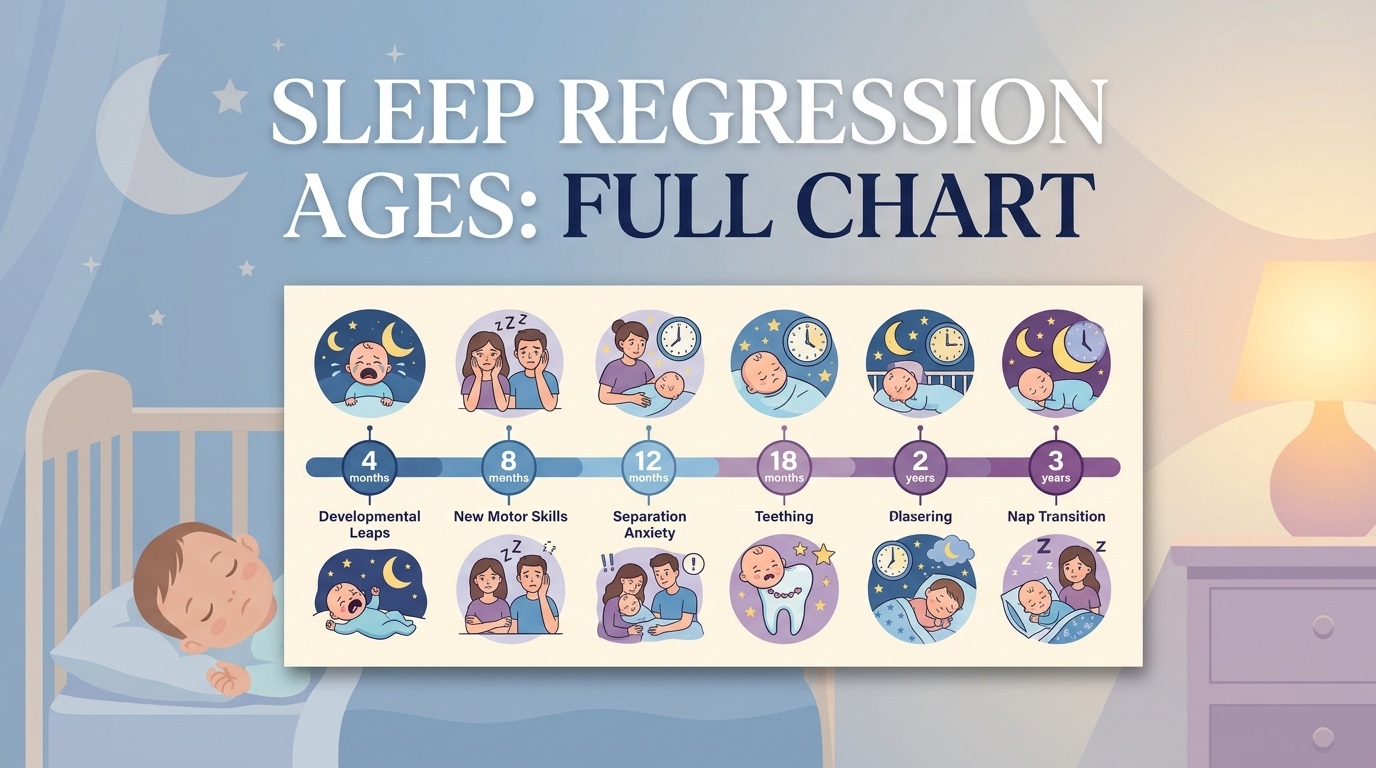
The graphic below should be used as a reference rather than a prediction. Outside of these times, an infant may have disordered sleep, miss a commonly reported regression entirely, or have many short bouts of problematic sleep.
| Age | Commonly Discussed Sleep Change | What Parents May Notice |
| Around 3–5 months | 4-month regression | More waking, shorter naps, difficulty settling |
| Around 6 months | 6-month change | New waking, nap changes, increased activity |
| Around 8–10 months | 8–9-month change | Separation concerns, mobility, bedtime resistance |
| Around 12 months | 12-month change | Standing/walking, nap transitions, increased independence |
| Around 15–18 months | Toddler sleep disruption | Nap resistance, separation, bedtime battles |
| Around 2 years | Toddler sleep disruption | Independence, language development, boundary testing |
These age ranges are approximate. The evidence does not support treating each row as a predictable medical event that every child will experience. Sleep changes are real; the calendar is much less predictable. Yale New Haven Hospital
Is My Baby’s Sleep Regression Real or Am I Just Exhausted?
Both are probably viable options.
Your tiredness is understandable, but a difficult week does not necessarily indicate that your infant is suffering a developmental “regression.” Babies’ sleep patterns fluctuate constantly, especially during the first year, and typical sleep may entail waking up in the night.
According to the American Academy of Pediatrics, babies do not have regular sleep cycles until around 6 months, and even at that age, they may wake up throughout the night and return to sleep after a short period of time. HealthyChildren.org
Before you characterize a change as regression, check for a pattern:
• Has your infant previously slept differently?
• Did the change occur around a developmental milestone?
• Does your baby feed, grow, and behave normally?
• Have there been any illnesses, trips, routine changes, or changes in childcare?
• Do naps suddenly become longer, shorter, or occur at various times?
If the answer to several of these questions is yes, you may be experiencing typical developmental or routine-related sleep disruption.
When do sleep regressions actually occur? A Month by Month Guide
There is no consistent month-to-month schedule for each baby. However, particular periods are frequently associated with changes in sleep, so understanding what is happening developmentally can be more valuable than memorizing a list of ages.
Around 4 Months: The Most Commonly Discussed Change
The so-called 4-month sleep regression is arguably the most familiar one for parents.
Around this age, infants’ sleep becomes more ordered. Babies continue to acquire more mature sleep habits, and the shifts between sleep stages become more evident. This may correspond with more frequent waking or shorter naps. According to pediatric sources, typical sleep cycles begin at this time, however individual babies may differ. HealthyChildren.org
You could notice:
• Waking up more frequently during the night.
• Unexpectedly brief naps.
• Have difficulties falling asleep.
• Increased need for assistance with settling.
• Increased awareness of surrounds.
This does not imply that you caused the problem or developed a bad sleep habit.
What Can Help?
Keep the bedtime routine predictable. For babies 4 months and older, the AAP suggests putting babies down when they are drowsy rather than waiting until they are completely asleep, which can help them learn to settle in their own sleep space. HealthyChildren.org
Most importantly, continue following safe-sleep practices even when you are exhausted.
Around 6 Months: New Skills Can Change Sleep
Six months is another age when parents sometimes report a sudden change.
At this point, babies may be more active and alert during the day. Rolling, sitting, reaching, babbling, and increased interest in people and surroundings can make it harder for some babies to settle.
But waking at 6 months is not automatically a regression.
The AAP notes that different babies have different sleep needs and that nighttime waking can still be normal at this age. HealthyChildren.org
What to Check
If sleep suddenly deteriorates, look at:
• Nap timing
• Bedtime consistency
• Feeding
• Room conditions
• Signs of illness
• New developmental skills
Do not assume every waking requires a change to the entire routine.
Around 8-10 months: Mobility and separation may interfere with sleep
During the second half of their first year, newborns become more mobile and socially aware.
A baby who has learnt to crawl or pull up can practice these skills in the crib. Separation anxiety might make bedtime more challenging.
A kid may
• Cry as you leave the room.
• Awake and look for yourself.
• Stay strong in the face of criticism
• Increase your bedtime activity.
These changes can occur every 8 or 9 months, but there is no set timeframe.
A Practical Response
Keep your response cool and predictable. A consistent bedtime ritual might serve as a helpful cue that sleep is on its way.
Avoid altering everything at once. When you introduce numerous new procedures at the same time, it becomes more difficult to assess which ones are effective.
Around 12 Months: The First Birthday Does Not Guarantee a Regression
The transition to toddlerhood can cause significant developmental changes.
Some children are:
• Pulling to stand.
• Cruising alongside furniture.
• Taking the first steps.
• Becoming more vocal.
• Showing strong preferences.
A child may be physically exhausted but eager to learn new abilities.
This can result in brief bedtime resistance or changes in naps.
However, a 12-month sleep disorder may not be due to “regression.” A schedule change, sickness, travel, or childcare transition can all have the same effect.
Around 15–18 Months: Nap and Independence Changes
As toddlers gain independence, sleep can become an expression of their growing desire for control.
You may hear:
• •“No!”
• Increased requests at bedtime.
• Resistance to taking naps.
• Crying after a parent leaves.
Some toddlers begin to transition from two naps to one around this time, however the timing varies.
If your child suddenly refuses to nap, don’t assume they don’t require daytime sleep. Examine their entire sleep time over a 24-hour period as well as their daytime activity.
Around 2 Years: Sleep Can Become a Boundary Issue
Two-year-olds are rapidly acquiring language, independence, inventiveness, and emotional regulation.
That can occur at bedtime.
A toddler may abruptly
• Request repeated drinks or stories.
• Stay out of bed.
• Leave the bedroom.
• Awake early.
• Feel upset when a parent leaves.
This is commonly referred to as the 2-year sleep regression, but it is not required that every 2-year-old have one.
At this age, setting consistent boundaries can be more beneficial than constantly changing the sleep routine.
How Much Sleep Does a Baby or Toddler Actually Need?
A sleep regression chart should not replace the bigger picture: total sleep over 24 hours matters.
The American Academy of Sleep Medicine recommends:
| Age | Recommended Sleep in 24 Hours |
| 4–12 months | 12–16 hours, including naps |
| 1–2 years | 11–14 hours, including naps |
| 3–5 years | 10–13 hours, including naps |
These are population-level recommendations, not a requirement that every child sleep exactly the same number of hours. AASM
A child who sleeps slightly differently from a sibling or friend is not necessarily sleeping poorly.
My Baby Won’t Sleep Longer Than 10 Minutes—Is This Normal?
A baby who repeatedly sleeps for only 10 minutes and then wakes deserves a closer look at the circumstances.
An isolated short nap is not necessarily concerning. Babies have variable sleep patterns, and young infants may sleep in short stretches. Newborns, for example, commonly wake every one or two hours, according to the AAP. HealthyChildren.org
But if every sleep attempt ends after only a few minutes, consider possible reasons such as:
• Hunger
• Overtiredness
• Noise or light
• Temperature
• Congestion
• Discomfort
• Difficulty settling
• A changing nap schedule
If your baby also has poor feeding, breathing problems, fever, unusual lethargy, or poor weight gain, don’t assume the problem is a sleep regression. Contact your pediatrician.
What Can Cause Sleep to Change Besides Regression?
This is one of the most important parts of understanding sleep regression ages.
A baby who suddenly sleeps poorly may simply be sick or uncomfortable.
Potential causes include:
Illness or Congestion
A stuffy nose can make sleep difficult. The AAP advises keeping the infant’s sleep environment safe rather than using an inclined sleep position to make breathing seem easier. Babies should continue to sleep flat on their backs on a firm, flat surface. HealthyChildren.org
Feeding Changes
Hunger can affect sleep, particularly in younger infants.
Parents sometimes search for how many bottles a day their baby should have, but there is no single number that applies to every baby. Feeding needs depend on age, growth, whether the baby receives breast milk or formula, and individual circumstances. Discuss feeding changes with your pediatrician, especially if growth or intake is a concern.
Development
Learning to roll, crawl, stand, walk, or communicate can temporarily change behavior around sleep.
Changes in Routine
Travel, visitors, illness, moving homes, or a new childcare arrangement can disrupt familiar sleep cues.
What If You’re Wondering When to Start Daycare?
Daycare itself does not create a universal sleep regression.
However, starting childcare can change a child’s daily rhythm. A new nap environment, different caregiver, unfamiliar room, or different nap timing may temporarily affect sleep.
If you’re deciding when to start daycare, consider the child’s overall needs and your family’s circumstances rather than choosing a date based solely on avoiding a supposed sleep regression.
When childcare begins, share your child’s usual sleep routine with caregivers. Consistency in familiar cues—such as a sleep sack, short routine, or preferred calming approach, where age-appropriate and safe—can make the transition easier.
Contact Naps: Are They a Problem?
Contact naps are naps where a baby sleeps while being held by a caregiver.
They can be a comforting way to settle a baby, and there is no need to feel guilty for holding your baby.
The safety issue is different from the question of whether contact naps are “good” or “bad.”
If there is a possibility that you may fall asleep, move the baby to their own safe sleep space. The AAP recommends that infants sleep on a firm, flat surface and not in an adult bed, couch, armchair, or other unsafe location. HealthyChildren.org
Safe Sleep Still Matters During a Sleep Regression
A difficult night can make exhausted parents tempted to use whatever arrangement produces sleep fastest. This is exactly when safe-sleep rules matter most.
For infants, the AAP recommends:
• Place the baby on their back for every nap and nighttime sleep.
• Use a firm, flat, non-inclined sleep surface.
• Keep pillows, loose blankets, stuffed toys, and other soft objects out of the sleep space.
• Keep the baby’s sleep area in the parents’ room, but not in the parents’ bed, preferably for at least the first 6 months.
Move a sleeping baby from a car seat, stroller, swing, or carrier to a firm sleep surface as soon as possible. HealthyChildren.org
These recommendations apply even when your baby’s sleep has suddenly become difficult.
What Parents Can Do During a Sleep Disruption
You do not have to completely rebuild your child’s routine every time sleep changes.
Keep the Routine Predictable
A short sequence—such as feeding, diaper change, pajamas, quiet activity, and bed—can give your child familiar cues.
The AAP recommends consistent bedtime routines as part of helping babies settle. HealthyChildren.org
Keep Nighttime Boring
For nighttime feeds or brief waking, keep lights low and interaction calm. The goal is to avoid turning a short waking into an extended period of play.
Watch for Sleepy Cues
Learn your child’s individual signs of tiredness.
These might include:
• Rubbing eyes
• Yawning
• Looking away
• Becoming fussy
• Losing interest in play
Waiting until a baby is extremely overtired can make settling harder.
Avoid Changing Five Things at Once
If sleep becomes difficult, choose one or two reasonable changes and give them time.
A completely different bedtime, nap schedule, feeding pattern, and sleep environment all at once can make the situation more confusing.
When Should You Call the Pediatrician?
Do not automatically blame a sleep problem on regression.
Talk with your child’s pediatrician if sleep disruption is accompanied by concerning symptoms such as:
• Trouble breathing
• Repeated breathing pauses
• Poor feeding
• Poor weight gain
• Persistent vomiting
• Fever or signs of illness
• Unusual lethargy
• Significant pain or discomfort
• A major, persistent change in behavior
If you are simply unsure whether your child’s sleep pattern is normal, it is also reasonable to ask.
A pediatrician can consider the child’s age, development, feeding, growth, medical history, and sleep pattern together.
How Long Does a Sleep Regression Last?
There is no scientifically established duration because “sleep regression” does not have a consistent medical definition.
Some children may have a short period of disrupted sleep, while others may experience a longer-lasting problem because something else is maintaining the waking.
If sleep does not improve, look beyond the regression label.
Ask:
“What is keeping my child awake?”
That question can reveal whether the issue is:
• Schedule
• Environment
• Feeding
• Illness
• Development
• Separation
• Sleep associations
• Another medical or behavioral concern
Frequently Asked Questions
At what ages do we see the most sleep regressions?
Parents report on sleep regressions at 4, 6, 8, 10, 12, 18, and 24 months of age which is a common trend. But these are approximate and not definitive medical markers. Also not all children go through a regression and sleep disruption may happen at other ages too.
Is the 4-month sleep regression real?
The at 4 months mark sleep may see great change but “4 month sleep regression” is a term used in parenting not a formal diagnosis. At this stage of growth infant sleep patterns tend to become more structured which in turn some babies do not do and instead wake more often and sleep in shorter intervals. The timing and extent of this may differ between children.
Does at what age does sleep regression hit babies?
No. There is not report that all babies go through sleep regressions at the same time. Some babies have what may be defined as sleep disruption at certain points in time, while others do not see much change in their sleep at all. Illness, development, feeding, routine, and environment play a role in how a baby sleeps.
How can I tell if my baby’s issue with sleep is due to something else?
See other signs to look for. Fevers, breathing problems, poor feeding, poor weight gain, persistent vomiting, severe pain, or atypical drowsiness should not be labeled as a regression. If you notice a large or continuous change in sleep patterns speak to your child’s pediatrician.
Should it be changed when my baby is going through a sleep regression?
Not at all. Night time awakening does not always point to hunger, and feed requirements do vary by age and what the child is like. With younger babies they may still be in need of night time feeds. If you are to reduce or at all change night time feeds, especially for a young infant, talk to your pediatrician first instead of just going by sleep charts.
Are contact naps safe?
Holding a baby while they nap is a comfort but the care provider should remain awake. If you do fall asleep put the baby in their separate safe sleep environment. According to the AAP it is recommended that you have a firm flat sleep surface, baby is put to sleep on their back and that you do not use loose bedding or soft accessories.
Can starting daycare cause sleep problems?
A different care setting may see your child’s nap times, routine, and sleep patterns change which is to say it isn’t sleep regression we are seeing from daycare. We do however see that sharing what your child’s routine is with caregivers and to keep things predictable at home will help maintain consistency.
Final Thoughts
From the growth chart of sleep regression what we take away is that these are guides for development of your child’s sleep patterns, not hard rules. At 4 months a baby that is waking more may just be going through normal sleep development changes, while for another baby at the same age we may see a different picture which has a different cause.
Your child’s age, growth, feedings, development, health and also recent changes in routine. Keep the bedtime routine predictable, practice safe sleep habits, and do not assume that every tough night requires a new approach.
If changes in sleep are associated with illness, breathing issues, feeding difficulties, poor growth, or any other concerning symptoms bring it up with your pediatrician instead of using a growth chart.