
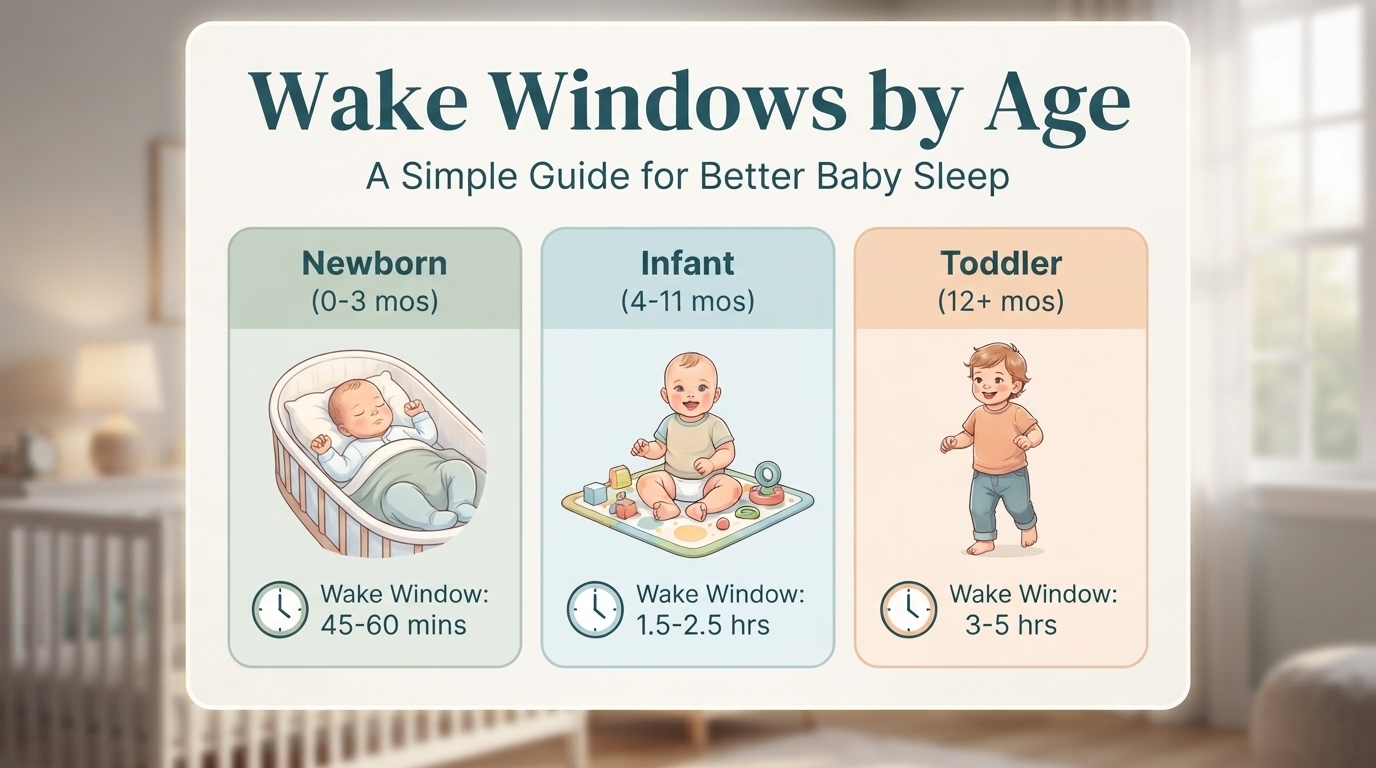

A Practical Baby Sleep Chart
I’m Dr. Noah, and during five years of working with families in my pediatric sleep clinic, I have found that understanding wake windows by age can make nap planning feel less confusing. One of the most common concerns parents bring to my clinic sounds simple: “My baby looks tired, so why will they not sleep?” In many cases, the baby was put down before enough sleep pressure had built—or after they had become very tired and upset. A wake window is not a strict deadline, though. It is a starting point that works best when you combine it with your child’s tired signs, feeding needs, and total sleep.
Wake windows are the periods between one sleep and the next. They generally become longer as a baby grows. A newborn may stay awake for less than an hour, while a toddler may manage five or six hours. Use the clock as a guide, but let your child’s behavior help you decide when sleep is needed.
What Is a Wake Window?
A wake window starts when your child wakes up and ends when they fall asleep again. It includes everything that happens during that period, such as feeding, diaper changes, playing, bathing, and the nap routine.
For example, if your baby wakes at 7:00 a.m. and falls asleep at 8:30 a.m., the wake window was 90 minutes. Time does not stop when you start to rock or feed your baby. It does so when your baby falls asleep.
Wake windows are that babies don’t always know when they are ready for a nap which is why parents have to look at the time, also the baby’s behavior, and recent sleep patterns to determine it.
Wake Windows by Age Chart
The following are approximate values which do not represent official medical guidelines. Research institutions put forth total daily sleep — but not wake window — charts which mostly reflect common infant sleep patterns.
| Age of child | Wake up time frame | Number of naps to expect |
| Birth to 6 weeks | 30-60 minutes | Several short naps |
| 6 – 12 weeks | 60-90 minutes | 4-6 naps |
| 3 to 4 months | 75 minutes to 2 hours | 3 to 5 naps |
| 5 – 6 months | 2-3 hours | 3-4 naps. |
| Between 7 and 9 months | 2.5 to 3.5 hours | 2 to 3 naps |
| 12 – 18 months | 3.5-5 hours | 1 to 2 naps. |
| From 18 to 24 months | 4.5 to 6 hours | Usually one nap |
| 2 – 3 years | 5-7 hours | 0-1 nap. |
These ranges overlap since children’s sleep needs do not vary on the day they turn a certain age. A 6-month-old may be fine with a two-hour window, whilst another may require closer to three hours.
Your youngster may potentially use many wake windows in the same day. The first one is usually shorter; however the one before bedtime may be longer.
How do Wake Windows change at each stage?
The chart’s value increases when you see what is going on in each age range.
Newborns: From birth to 10 weeks.
Newborn sleep is very irregular. A young baby may wake up, feed, have a diaper change and then they are right back off to sleep.
Do not expect a strict nap schedule from a newborn. Their feeding and sleep requirements may vary each day. Wake time is typically between 30-90 minutes but for some that may be out of that range.
Start to watch for signs of tiredness right after feeding. Keep stimulation to a minimum, especially if your baby has been awake for most of the expected time.
3 to 4 Months
At this age, babies frequently become more interested in faces, sounds, and objects. Their increased interest may make them appear less weary than they actually are.
Many babies can be awake for 75 minutes to two hours. Their sleep pattern may become more consistent; however, brief naps and fluctuating patterns remain prevalent.
If your baby starts resisting their naps, don’t assume they no longer need them. Try moving the nap 10 to 15 minutes later for a few days and see what happens.
5 to 6 Months
At this point, a two- to three-hour wake window may be sufficient. Many babies begin to transition to three regular naps, but this does not occur at the same age for everyone.
If a late afternoon nap frequently pushes bedtime too late, your infant may be ready to give up that nap. Before removing it, observe the pattern for a few days. One missed nap does not indicate that a lasting adjustment is required.
7 to 9 Months
During this time, many babies drop from 3 naps to 2. Also they may be awake for 2.5 to 3.5 hours at a stretch which varies by time of day and quality of sleep.
Signs that your little one may have outgrown the idea of a third nap include when they start to turn it down, take very late naps, or have trouble settling at bedtime. As the transition happens an earlier bedtime may work for those days when your baby is only interested in 2 short naps.
10 to 12 Months
Two naps are still common, with wake periods of roughly three to four hours. Some babies begin refusing one nap, but that does not always mean they are ready for a one-nap schedule.
Developmental changes can briefly disturb sleep. Standing, crawling, separation anxiety, illness, and teething may all affect naps. Give the pattern time before making a large schedule change.
12 to 18 Months
Toddlers often move from two naps to one between 12 and 18 months. During this transition, some days may still need two naps while others work with one.
A toddler who is truly ready for one nap may refuse a nap for one or two weeks, remain fairly content while awake, and still sleep well at night. If your child becomes extremely upset before lunch or regularly falls asleep during morning activities, the change may be too early.
As feeding becomes a larger part of the daily routine, planning simple [INTERNAL LINK NEEDED: toddler meal ideas] can also make the period before a midday nap calmer.
18 Months to 3 Years
Most toddlers in this age range take one midday nap, although some stop napping before age three. Wake periods may last between 4.5 and seven hours.
Do not remove the nap only because bedtime becomes difficult for one or two nights. First try shortening the nap by 15 to 30 minutes or moving it slightly earlier. A child who is cheerful without a nap and sleeps well overnight may be ready to stop, but an irritable child who falls asleep in the car every afternoon may still need daytime rest.
Look at Your Child, Not Only the Clock
A wake-window timer cannot tell you whether your baby is hungry, ill, uncomfortable, or tired after a poor nap. Use the expected range as a reminder to start watching your child more closely.
Early Signs That Sleep May Be Near
Your baby may:
- Turn away from toys or faces
- Become quieter
- Stare into the distance
- Move more slowly
- Rub their eyes
- Yawn
- Seek more physical comfort
These signs can be subtle. Beginning a short nap routine at this stage is often easier than waiting for crying.
Signs Your Child May Already Be Very Tired
A very tired baby may become fussy, cry, arch their body, resist soothing, or seem unusually active. Toddlers may run around, become clumsy, or have a sudden tantrum.
These behaviors do not always mean overtiredness. Hunger, discomfort, illness, and overstimulation can look similar. Consider when your child last slept, ate, and had a diaper change before deciding what they need.
Is the Wake Window Too Short or Too Long?
A single difficult nap does not tell you much. Look for the same pattern over at least three days when your child is healthy.
The Window May Be Too Short If:
- Your child appears happy and alert during the nap routine.
- They take more than 20 minutes to fall asleep.
- They play, talk, or roll around instead of settling.
- They take a very short nap but wake in a good mood.
Try extending the window by 10 to 15 minutes. Keep the new time for several days before changing it again.
The Window May Be Too Long If:
- Your child becomes upset before the nap begins.
- They fall asleep during feeding or the nap routine.
- Settling becomes harder as the day continues.
- They take short naps and wake crying.
- The same pattern happens repeatedly after long periods awake.
Move the nap routine 10 to 15 minutes earlier. Large changes can make it difficult to understand what helped.
Should You Follow Wake Windows or Hunger Cues?
Respond to hunger cues first. Do not delay a needed feed simply because the wake-window chart says it is time for sleep.
Young babies often need to eat frequently, including during the night. The NHS recommends responsive feeding, which means feeding a baby when they show hunger rather than following a rigid clock-based schedule.
Common hunger signs include:
- Turning toward the breast or bottle
- Putting hands in the mouth
- Smacking or licking the lips
- Opening and closing the mouth
- Becoming restless
Crying is a sign that may come very late. CDC’s infant feeding guidance says to pay attention to your child’s individual hunger and fullness signals.
If at the end of a wake period your baby feeds, do the same to put them back to sleep. They may wake up and feed then go right back to sleep. You do not have to extend the wake period or keep them awake because they ate.
Follow out any specific feeding guidelines that your pediatrician may have given you for your baby which may include newborns, preterm babies, or those with growth issues.
Total Sleep Matters More Than a Perfect Schedule
Wake windows solely describe the time spent awake. They do not show whether your youngster is receiving adequate sleep during the entire day and night.
The American Academy of Sleep Medicine recommends:
· Between 12 to 16 hours of sleep in a 24-hour period which includes naps.
· Between 11 to 14 hours which includes naps.
· Between 10 to 13 hours which includes naps.
There is a lack of a formal AASM recommendation for babies under 4 months which is due to the fact that newborn sleep varies greatly. Also NHS explains that newborn sleep can range considerably, that there is a wide range in newborn sleep and that short and irregular sleep periods are very common.
If your child is resting well, feeding properly, growing as he should, and has appropriate awake periods small differences from what the online charts show are not a big issue.
Build a Simple Nap Routine
A short nap routine is what you need. 5 to 10 minutes is all it takes to mark the end of active time.
Try this sequence:
· End strong
· Change a diaper if required.
· Darken the room.
· Wear suitable sleepwear.
· Read a brief book or sing softly.
· Place your baby in a proper sleep environment.
Use a similar routine each day but if your baby is very tired skip the book and go straight to sleep.
Wake Windows Should Never Replace Safe Sleep
At the right time a nap may not be of use if the sleep setting is not safe. It is recommended that babies sleep on their backs, in a firm flat surface designed for infants.
According to HealthyChildren.org from the American Academy of Pediatrics, sitting devices like car seats, swings, and strollers are not to be used for regular infant sleep, especially for babies under 4 months old.
In the crib or bassinet, remove pillows, loose blankets, toys, bumpers, nests and sleep positioners. Health Canada’s safe-sleep guidance also says to use a firm flat mattress with a tight-fitting sheet and no soft products.
When to Bring Up Issues with your Pediatrician?
Contact your health care provider if your baby is slow to wake, has poor feeding, shows signs of breathing difficulty, displays atypical movements during sleep, or is not growing as expected.
Also when in doubt ask for help if sleep issues are very bad, of if they last for some weeks or they cause safety issues for your family. Also bring in to see a doctor if you have very loud snore, of your child is gasping or has long breathing breaks which is out of the ordinary, or if what is going on is very different from what is normal for your child.
A wake window adjustment does not treat reflux, breathing issues, pain, allergies, or other health conditions.
FAQS
Do wake windows include feeding time?
Yes. When your baby wakes that is the start of the wake window which includes feeding, diaper changes, play, and the nap routine. Do not add in extra awake time after a feed to hit a mark on the chart.
Is uniformity in wake windows ideal?
Not really. In the morning, your baby may only do a short nap and then in the evening they may sleep for a longer time. Also, play, health issues, and growth may affect how long your child will sleep before becoming tired.
Should I lengthen the next window after a short nap?
You may try to reduce naps by 10 to 20 min if your baby is tiring out at different times. Also do not assume that every short nap means a change in routine is required. Pay attention to your baby’s cues and look for what is consistent.
When should a toddler stop napping?
There is not one set age at which this happens. Some kids stop napping by age 3 while others are still dozing past that. Look at your child’s disposition, bedtime, overnight sleep, and behavior on the nights they don’t nap. Quiet time may take the place of the nap during this transition.
Do medical studies support wake windows?
Wake periods are a practical guide that we use to plan rather than formal medical orders. Professional organizations put out age-based recommendations for total sleep but do not give exact awake times for each baby. Use wake window ranges along with signs of tiredness, feeding requirements and also what your pediatician recommends.
Can waking windows work for baby sleep?
Suit at the right time may make naps and bedtime better but wake windows do not guarantee straight through night sleep. Babies may wake due to hunger, development, discomfort, illness, or a need for comfort. Night waking is common in the infant stage.
Identify what works for your child
The greatest wake windows by age chart is one that you can utilize with ease. Begin with the appropriate range for your child’s age, monitor for tiredness, and adjust the following sleep by only 10 to 15 minutes as needed. Track your sleep for three to five days before making another modification. Your child’s pattern is more important than following the clock flawlessly.
This article was submitted by Dr. Noah, a pediatric sleep medicine specialist who has operated his own clinic for five years.