

A Vet Explains
By Dr. Rosie, Veterinarian
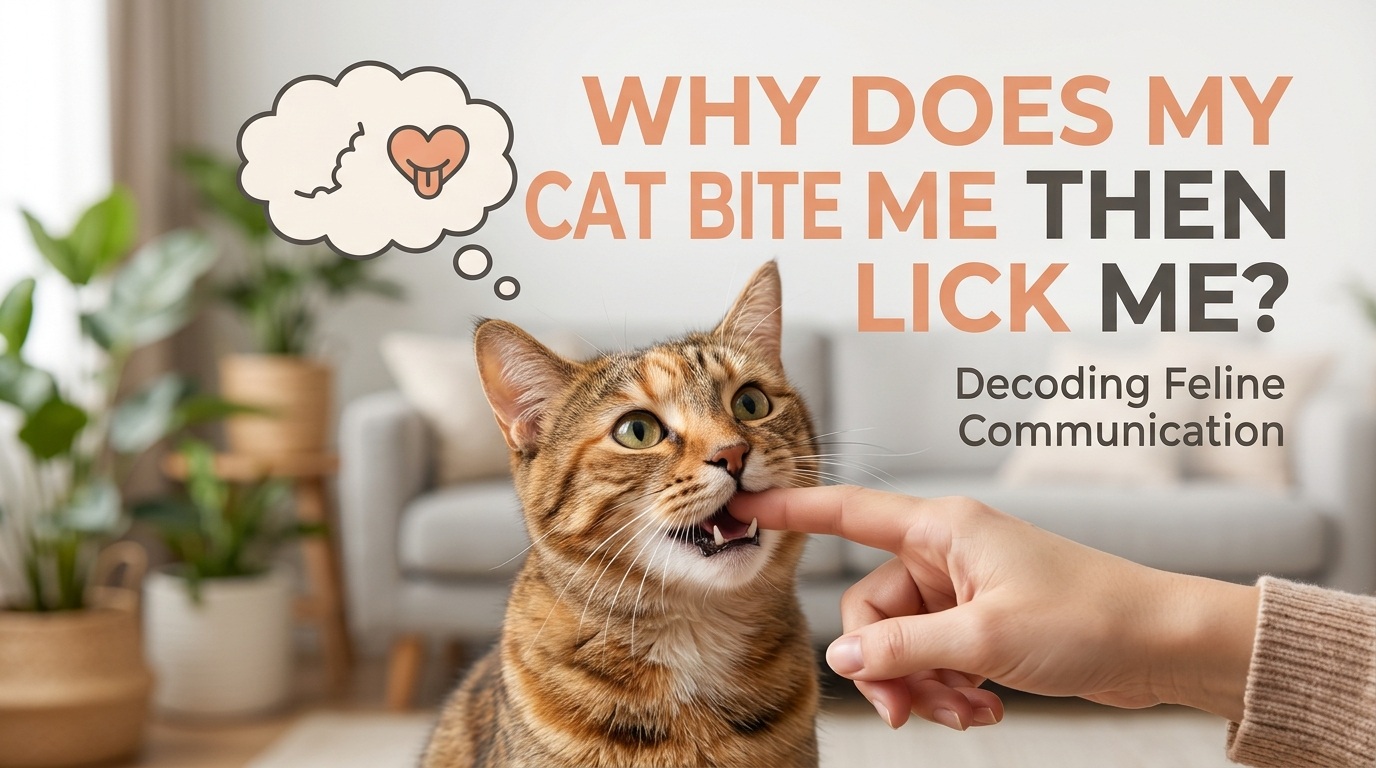
A cat may be cuddled up next to you, purring while you pet them, and then suddenly lick the same spot and bite your hand. Cat owners often ask themselves, “Why would my cat bite me if they appear happy?” when they witness such behavior. I’m Dr. Rosie, a veterinarian with years of experience treating cats in my practice and thru volunteer work. The answer isn’t always aggression. A light bite followed by licking could be a sign of play, excitement, social grooming, or that your cat is tired of being petted.
It’s critical to learn how to evaluate the bite in relation to your cat’s body language and any recent behavioral changes. A cat may be playing, grooming, or responding to overstimulation if they softly bite you before licking you. A hard bite accompanied by flattened ears, tail lashing, hissing, or attempts to run away are very different from a gentle nibbling with relaxed body language. Abrupt new biting may sometimes be a sign of illness or pain. Cornell Vet School
Why does my cat lick me after biting me?
The bite-then-lick sequence has multiple meanings. Context is crucial since cats utilize their lips for play, grooming, hunting, social interaction, and defense. I start by examining what transpired before to the bite. Did you spend a few minutes petting your cat? Were you playing with your hands? Did your cat approach you gently and start licking first? Or did the habit come unexpectedly in a cat who often adores being touched?
Those details can help distinguish between innocent communication and a problem that requires attention.
1. Your cat may be grooming you
Cats with friendly social interactions may groom each other, a habit known as all grooming. Mutual grooming, according to International Cat Care, is one of the pleasant actions that cats can engage in with known cats. According to International Cat Care, certain cats may exhibit grooming behavior toward humans they feel comfortable with. They may lick your hand, nibble briefly, and then continue to lick.
This does not imply that every bite followed by a lick is a statement of love. We can’t ask the cat what they intended. However, if the bite is quite soft and your cat remains loose, comfortable, and near to you thereafter, social grooming could be a plausible explanation.
What Your Cat Might Look Like During a Calm Interaction:
• Stay lying next to you.
• Maintain a neutral position for the ears.
• Display relaxed facial muscles
• Keep touching or licking you.
• Remain close to you rather than attempting to depart.
• Instead of biting hard, give a very gentle nip.
Instead of attempting to translate a single action in isolation, consider the entire interaction.
2. The Bite Could Signify “I’ve Had Enough Petting”
When biting occurs during a cuddle, this is one of the most frequent explanations I would take into account.
For a limited period of time, some cats prefer to be stroked. Petting-induced aggression is defined by Cornell University’s Feline Health Center as when a cat unexpectedly bites while being petted. Overstimulation or the cat attempting to regulate when petting ceases are potential causes. Cornell Vet School
Cornell lists indicators like:
• Twitching or whipping the tail
• Backward-moving ears
• Dilated eyes
• Tension in the body is rising Cornell Vet School
The cat may also turn its head in the direction of your hand.
Instead of waiting for the bite, stop caressing if you see these changes.
It’s a very human perspective to say that a cat who licks you thereafter has “apologized.” After the interaction, the licking can just be another self-regulating or grooming behavior.
3. It’s Possible Your Cat Is Playing
Feline play also includes biting.
As hunters, cats frequently engage in stalking, chasing, snatching, kicking, and biting during play. Your cat might keep clutching if they discovered as a kitten that hands are toys.
The CDC warns against rough play with kittens and cats because it can lead to bites and scrapes as the cats get older. CDC
Redirect your cat to a suitable toy if they start playing with your hands. Because they allow the cat to chase and retrieve objects without bringing your fingers in close proximity to their jaws, wand-style toys are beneficial. In a similar vein, Cornell advises controlling play aggressiveness by keeping playthings out of your hands. Cornell Vet School
4. A Soft Bite Can Be a Boundary, Not Aggression
A light cat nip is referred to by some owners as a “love bite.” It is not an accurate veterinary diagnostic, but it is a useful descriptor.
A gentle bite could happen during a loving exchange, but it could also be your
“That’s enough.”
Pay attention to what happens next.
If your cat gives one light bite, releases immediately, remains relaxed, and continues sitting beside you, the situation is quite different from a cat that clamps down, grabs with the front paws, kicks with the back legs, growls, or repeatedly attacks.
Soft Bite vs. Concerning Bite
| Behavior | More Likely Interpretation |
| Brief, gentle nibble | Social behavior, play, or mild boundary |
| Bite after prolonged petting | Possible overstimulation |
| Grabbing and bunny-kicking | Play or high arousal |
| Hissing with ears flattened | Fear, distress, or defensive aggression |
| Sudden hard biting when touched | Possible pain or discomfort |
| Repeated unprovoked attacks | Needs closer behavioral/medical assessment |
No table can diagnose your individual cat, but these patterns can help you decide what to watch next.
Do Cats Usually Bite and Lick You?
If your cat has always engaged in delicate bite-and-lick interactions and no one is being harmed, it may be considered normal feline behavior.
Change, context, and intensity are important.
A 10-year-old cat that abruptly starts biting if you touch their hip is not the same as a kitten who playfully mouths your palm.
The cat’s typical baseline should always be used to interpret behavior.
What Does a Soft Bite from My Cat Mean?
A gentle bite typically prompts me to consider three options first:
1. Social or grooming-related actions
2. Play
3. A request to refrain from touching
By observing the circumstances, you can frequently refine it.
Grooming-like engagement is possible if the cat is at ease and licking comes first. Play may be more likely if the cat is following your moving fingers and your pupils are huge. Overstimulation rises on the list if the bite happens after a few minutes of stroking and the tail twitches first.
Does Purring Mean the Bite Is Affectionate?
Not necessarily.
Cat behavior is best read as a collection of signals rather than using one behavior as proof of a particular emotion.
If you are wondering why do cats purr, remember that purring can happen in different contexts. Do not ignore tense body language simply because a cat is also making a familiar sound.
[INTERNAL LINK NEEDED: why do cats purr]
The same principle applies if your cat is kneading your lap before biting. Why do cats knead? Kneading itself is a normal feline behavior, but its presence does not guarantee that your cat wants unlimited petting. International Cat Care describes kneading as normal behavior in cats. International Cat Care
[INTERNAL LINK NEEDED: why do cats knead]
Where You Pet Your Cat Can Matter
Not every cat likes being touched everywhere.
Some cats seek head and cheek contact but become uncomfortable when people repeatedly stroke the belly, lower back, tail area, legs, or paws.
Your own cat’s preference matters more than a universal petting map.
Let your cat approach you when possible. Start with short interactions and stop while the cat is still relaxed. Cornell recommends brief, light stroking for cats prone to petting-induced aggression and stopping physical contact when warning signs appear. Cornell Vet School
This approach often works better than trying to teach the cat to tolerate longer handling sessions.
When Biting May Mean Pain
A sudden personality change deserves more attention than a behavior your cat has shown gently for years.
Cats experiencing pain may become more defensive when touched. Cornell specifically identifies pain-induced aggression and notes that cats with painful conditions may hiss, bite, or scratch when sensitive areas are touched. Cornell Vet School
AAHA also lists aggression during handling among behavioral changes that can accompany feline pain. Cats may show other subtle signs such as hiding, changes in movement, reduced grooming, or changes in facial expression. AAHA
Arrange a Veterinary Check If You Notice:
• Biting that begins suddenly
• Biting only when one body area is touched
• Limping or reluctance to jump
• Hiding more than usual
• Reduced appetite
• Changes in litter-box habits
• Reduced grooming or excessive grooming
• Vocalizing when touched
• A major change in activity or personality
Do not punish these behaviors before ruling out a medical cause.
Excessive Licking Can Be a Clue Too
Licking itself can occasionally signal a problem.
Cornell notes that cats may focus licking on areas that are itchy or painful. Excessive grooming can be associated with issues ranging from parasites and allergies to pain or stress. Cornell Vet School
If your cat is licking you, that is not the same as over grooming their own skin. But if you also notice your cat repeatedly licking or chewing one part of their body, losing hair, or creating sores, mention it to your veterinarian.
When your cat bites you, how should you react?
The circumstances will determine how you respond.
If It’s a Light Nibble
Take a moment to stop moving your hand and observe your cat’s behavior.
Calmly cease the petting session if the cat appears overstimulated.
You don’t have to spray water, tap the cat, or yell.
If It Occurs While Playing
Offer a toy that puts space between your fingers and the cat’s mouth while moving your hands away.
Your cat will have a better chance of learning that human hands are not wrestling toys if rough play stops as soon as teeth make contact with skin.
Avoid Punishing Your Cat Physically
Physical punishment during aggressive behavior should be avoided, according to Cornell, as it could make cats wary of people or even be mistaken for play. Cornell Vet School
Punishment also doesn’t address the most important point, which is why the bite happened.
Finding the cause and keeping the cat from being that aroused is typically more fruitful.
Find Out Your Cat’s “Petting Limit”
Some cats will gladly spend an hour on your lap, but they only want to be stroked for thirty seconds.
Count the number of strokes that typically occur prior to the initial head rotation or tail twitch.
The following time, halt after five or six strokes if your cat usually becomes uncomfortable after eight.
This is not about adhering to a precise figure indefinitely. While the encounter is still enjoyable, it assists you in observing your cat’s threshold and terminates contact.
What Happens If My Kitten Continues to Lick and Bite Me?
During play, kittens bite, pursue, wrestle, and explore.
I would be very cautious not to promote hand wrestling at this point. To prevent future bites and scrapes, the CDC advises against rough play with cats. CDC
Instead, provide lots of suitable play areas.
Kittens can chase and grab during brief sessions with wand toys, balls, or other safe cat toys without realizing that their fingers and ankles are prey.
What Would Happen If My Older Cat Started Biting All of a Sudden?
Don’t dismiss the conduct as “becoming grouchy with age.”
Conditions that make movement or touch painful can develop in older cats. Sometimes, behavioral changes are the first indication that a physical change has occurred.
Regular veterinary exams are important because changes in daily behavior may indicate medical issues. The AAHA/AAFP feline life-stage guidelines place a strong emphasis on observing minor behavioral changes in cats as they get older. AAHA
In addition to the biting behavior, it’s important to know how long cats live and what changes to anticipate as they age.
What Should You Do If Your Skin Is Injured by a Cat Bite?
Just because the cat is your personal pet doesn’t mean you should ignore this section.
Small puncture wounds caused by cat teeth have the potential to get infected. According to the CDC, even if an injury doesn’t seem serious at first, cat bites and scratches can spread diseases. CDC
Right After a Bite
Use warm, soapy water to immediately wash the wound. CDC
Get the right medical advice if the wound is severe becomes red, painful, warm, or swollen, the cat appears ill, the rabies vaccine status is uncertain, or you have other concerns. The CDC, NHS, and Canadian health standards all emphasize the significance of cleaning animal bites as quickly as possible and getting medical help when the wound or risk of infection necessitates it. CDC
Hand bites may need special attention since serious punctures may damage structures beneath the skin.
If your cat regularly bites with enough force to break skin, address both elements of the problem: arrange for a behavioral or veterinary assessment for the cat and, if required, get medical care for the human wound.
When Should You Consult Your Veterinarian About Biting?
I advise scheduling a veterinary consultation when the behavior is:
• A recent or unexpected deterioration.
• Far more powerful than previous bites from your cat.
• Activated by touching a designated spot.
• Changes in appetite or hiding are possible symptoms.
• Associated with limping or trouble jumping.
• When combined with skin problems or excessive grooming.
• Takes place in an unclear social or play setting.
• Endangering children and other household members.
Behavior can be influenced by pain, anxiety, stress, skin disorders, neurological issues, and other physical ailments. Before determining if a licensed feline behavior specialist is needed, a veterinarian might check for physical problems.
Frequently Asked Questions
Why does my cat attack me so forcefully after licking me?
It may indicate overstimulation if your cat bites after being licked or petted. Keep an eye out for body stiffness, dilated pupils, tail movement, and backward-moving ears. Any recurrent or strange behavior should be discussed with your veterinarian because a hard or recently acquired bite may indicate pain.
Why does my cat purr and gently bite me?
In a relationship that is otherwise comfortable, a gentle bite could be a sign of play, social interaction akin to grooming, or a petting boundary. Your cat can’t tell you exactly how they’re feeling just by purring. Examine the pupils, ears, tail, posture, and the events leading up to the bite.
Why does my cat grab my arm, bite, and kick?
Sometimes, especially in young cats, this pattern resembles frenzied play or hunting behavior. Play with a wand or other toy that is kept away from your body instead of your hands. Cornell advises keeping playthings out of children’s hands when dealing with play aggression.
Should I allow my cat to give me “love bites”?
Just because biting is gentle does not mean you have to put up with it. You may decide not to react forcefully if the behavior is not dangerous and does not worsen. Instead of punishing your cat, just end the relationship when fangs come into contact with flesh and switch play to a suitable toy if you want it to stop.
Does my cat feel sorry when it licks me after biting?
The conclusion that the lick is an apology in the human sense is unsupported. It could be persistent interaction, social grooming, or another common feline behavior. Think at the circumstances around the bite and your cat’s body language instead of placing blame.
Why does my cat bite only one person?
Different people touch, play with, approach, and respond to cats in different ways. One person may pet for an extended period of time, use their hands during play, or ignore early indications that the cat want to discontinue touch. Examine interactions closely before believing the cat simply dislikes that person.
The Bite and Stroke are Only the Tip of the Iceberg.
If you are confused as to why your cat has bitten you, begin to pay attention to what transpires before and after the bite.
A gentle nip and a session of licking from a content cat may just be a social greeting or play. A bite after much petting may indicate that your cat has had enough. A sudden sharp bite in particular when a certain body part is touched in to which the cat has a problem with, requires immediate attention as it may be a sign of discomfort or illness. Cornell Vet School
I would advise that you pay attention to early warning signs. Also put your cat’s play sessions short, give them appropriate toys, do away with physical punishment, and take them to the vet if the behavior changes suddenly or it becomes out of hand.